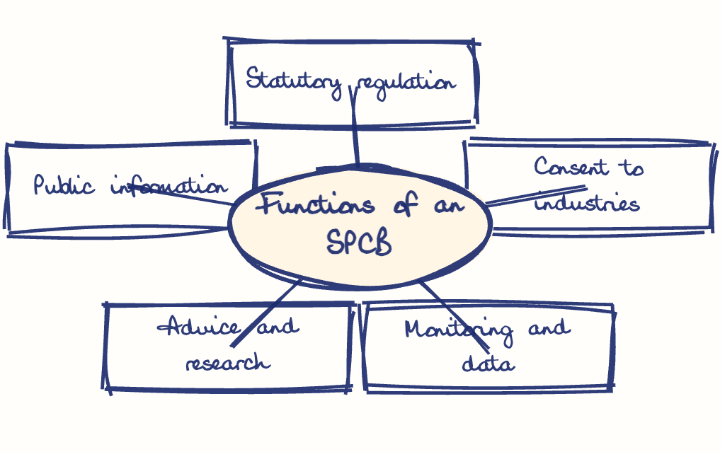
Narrate the functions of State Pollution Control Board.
In short
State Pollution Control Boards, set up under the Water Act, 1974 and Air Act, 1981, grant consents to industries, monitor air and water quality, enforce standards and advise state governments. Staff shortages, weak data and poor transparency limit them, including in Andhra Pradesh's industrial corridors.
Model answer
Ghissu Editorial · Verified 4 Oct 2026 · 254 words
Statutory Mandate and Consent Role
SPCBs derive authority from the Water (Prevention and Control of Pollution) Act, 1974, Air Act, 1981, and Environment (Protection) Act, 1986, granting consents to industries, exemplified by the Visakhapatnam-Chennai corridor in Andhra Pradesh.
Monitoring and Data Integration
They maintain monitoring networks contributing to the National Air Quality Monitoring Programme (NAMP) and National Water Quality Monitoring Programme (NWMP), essential for tracking pollution trends.
Resource Constraints and Enforcement Gaps
Many SPCBs, including Andhra Pradesh, suffer from staffing shortages and technical limitations, hindering enforcement despite mandates like Continuous Emission Monitoring Systems (CEMS).
Industrial and Urban Waste Management Issues
Compliance varies; 83% of Grossly Polluting Industries in the Ganga basin met standards in 2024, but Andhra Pradesh’s urban local bodies reveal solid waste management audit gaps5 (2022) with few sanitary landfills operational.
Capacity Building and Coordination
Enhancing technical infrastructure and inter-agency data sharing platforms can improve enforcement and holistic pollution control, especially in industrial clusters of Andhra Pradesh.
Transparency and Public Engagement
Mandating proactive pollution data disclosure and involving communities can boost accountability and compliance.
This model answer is indicative and the model can make mistakes; please verify key facts independently.
Practise this question
1Get the answer sheet
Sized for this question.
2Write your answer
Timed, by hand.
3Get it marked
Your score and what to fix.
This chapter in the exam
Pollution & solid waste; global issues; environmental legislation; disaster management policy; agricultural revolutions43 questions
Asked in 8 of 8 sittings since 2008
Most tested: Solid waste management and pollution-control legislation
- 2025What are the key principles of Integrated Solid Waste Management (ISWM)? Discuss the role of waste hierarchy in ISWM.
- 2025Define global warming, and differentiate it clearly from climate change. Explain the key natural and human-induced causes of global warming and briefly discuss which factors are currently dominant in driving global temperature rise.
All 43 questions, sorted by sub-topic, with model answers and practice.
Question from the official APPSC Group-I Mains 2016 paper. Answer written by Ghissu's engine and checked against our editorial standards. Found an error? Tell us and we correct it within 48 hours.