Narrate various types and the characteristics of Solid Waste.
In short
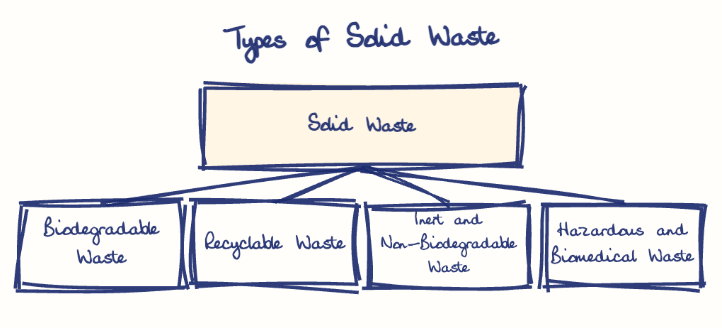
Solid waste has four main types: biodegradable (food and garden waste), recyclable (plastics, paper, glass, metals), inert (construction debris that does not decompose) and hazardous or biomedical waste needing special handling. Each needs its own treatment, yet Andhra Pradesh's 123 ULBs had only 4 sanitary landfills in 2022.
Model answer
Ghissu Editorial · Verified 4 Oct 2026 · 296 words
Fragmented Roles and Weak Coordination
Multiple bodies like municipal corporations and pollution boards manage waste, but coordination gaps persist; only 5 of 17 Andhra Pradesh ULBs had SWM bye-laws by 2022. This fragmentation hampers unified policy implementation and resource optimization.
Data Deficiency and Capacity Constraints
Accurate waste data is scarce; Andhra Pradesh’s 123 ULBs generated ~6,890 tons/day in 2022, but segregation and processing data remain incomplete. Additionally, many ULBs lack technical and financial capacity to adopt scientific waste management, limiting progress.
Recyclable and Inert Waste
Recyclables (~17%) include plastics (9.4 million tonnes annually in India), paper, metals; inert waste (~32%) like construction debris requires specialized disposal, yet many landfills lack proper liners, causing contamination. Innovative recycling and co-processing methods are being promoted to mitigate environmental impact.
Infrastructure Deficits
Only 4 Andhra Pradesh ULBs had sanitary landfills and 82 lacked wet waste plants (2022), leading to dumping and pollution. This infrastructure gap undermines effective waste treatment and environmental safety.
Segregation Compliance Issues
Andhra Pradesh audits showed ~75% segregation in 2024, revealing enforcement and public participation gaps. Strengthening awareness and monitoring is essential to improve segregation rates.
This model answer is indicative and the model can make mistakes; please verify key facts independently.
Sources
Practise this question
1Get the answer sheet
Sized for this question.
2Write your answer
Timed, by hand.
3Get it marked
Your score and what to fix.
This chapter in the exam
Pollution & solid waste; global issues; environmental legislation; disaster management policy; agricultural revolutions43 questions
Asked in 8 of 8 sittings since 2008
Most tested: Solid waste management and pollution-control legislation
- 2025What are the key principles of Integrated Solid Waste Management (ISWM)? Discuss the role of waste hierarchy in ISWM.
- 2025Define global warming, and differentiate it clearly from climate change. Explain the key natural and human-induced causes of global warming and briefly discuss which factors are currently dominant in driving global temperature rise.
All 43 questions, sorted by sub-topic, with model answers and practice.
Question from the official APPSC Group-I Mains 2016 paper. Answer written by Ghissu's engine and checked against our editorial standards. Found an error? Tell us and we correct it within 48 hours.