What are Bio fertilizers? Explain different types of bio fertilizers? Write advantages of bio fertilizers?
In short
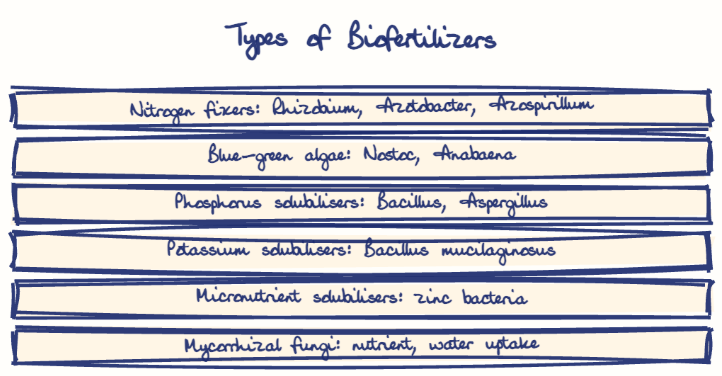
Biofertilizers are living microbial inoculants that enrich soil by fixing nitrogen or solubilising nutrients, and include nitrogen fixers (Rhizobium, Azotobacter, Azospirillum, blue-green algae), phosphorus and potassium solubilisers and mycorrhizal fungi. They cut chemical fertilizer use and pollution, improve soil health, lower farmers' costs and raise yields.
Model answer
Ghissu Editorial · Verified 4 Oct 2026 · 315 words
Biofertilizers Explained
These contain beneficial microbes such as Rhizobium, Azotobacter, and blue-green algae that fix atmospheric nitrogen or solubilize phosphorus, improving nutrient availability biologically without harmful chemicals.
Classification
Major types include nitrogen fixers (Rhizobium for legumes, Azospirillum for cereals), phosphorus solubilizers (Bacillus, Pseudomonas), potassium solubilizers (Bacillus mucilaginosus), and mycorrhizal fungi that enhance nutrient and water uptake, improving drought and salinity tolerance.
Environmental and Soil Benefits
Biofertilizers reduce chemical fertilizer dependency, lowering soil and water pollution and greenhouse gas emissions. They improve soil microbial diversity and organic matter, enhancing soil structure and moisture retention, crucial for drought-prone areas like Rayalaseema.
Economic and Yield Impact
They are cost-effective for farmers, can be locally produced, and reduce input costs. By improving nutrient uptake, biofertilizers increase crop yields and quality, supporting Andhra Pradesh’s agricultural sustainability and food security.
This model answer is indicative and the model can make mistakes; please verify key facts independently.
Practise this question
1Get the answer sheet
Sized for this question.
2Write your answer
Timed, by hand.
3Get it marked
Your score and what to fix.
This chapter in the exam
Human diseases; genetic engineering basics; biotechnology in agriculture; vaccines54 questions
Asked in 8 of 8 sittings since 2008
Most tested: Vaccines and immunisation, alongside GM crops/biotech agriculture.
- 2025Discuss the transmission dynamics of respiratory tract infections in densely populated urban settings. Propose effective public health strategies for their prevention.
- 2025Examine how urban infrastructure influences the implementation of preventive measures during microbial disease outbreaks. Suggest technology-driven solutions.
All 54 questions, sorted by sub-topic, with model answers and practice.
Question from the official APPSC Group-I Mains 2016 paper. Answer written by Ghissu's engine and checked against our editorial standards. Found an error? Tell us and we correct it within 48 hours.