What are Vitamins? Give a detailed classification of vitamins mentioning their functions and sources of availability?
In short
Vitamins are organic micronutrients needed in small amounts, mainly as enzyme cofactors, classified as fat-soluble (A, D, E, K), which the body stores, and water-soluble (B complex and C), which need regular intake. Their deficiency causes specific diseases, such as night blindness (vitamin A) and scurvy (vitamin C).
Model answer
Ghissu Editorial · Verified 4 Oct 2026 · 289 words
Definition and Importance
Vitamins act as enzyme cofactors required in small amounts, facilitating metabolism without providing energy, as per Indian Council of Medical Research (ICMR) Nutrient Requirements (2020). Deficiencies cause diseases such as night blindness and scurvy.
Classification and Functions
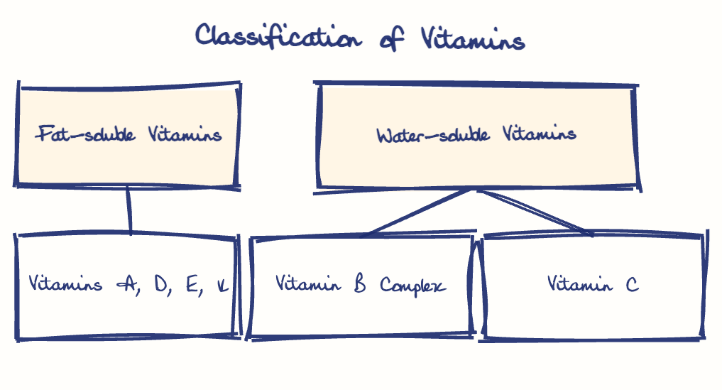
Fat-soluble vitamins (A, D, E, K) dissolve in fats, stored in liver and tissues; vitamin A supports vision, vitamin D aids calcium absorption, vitamin E protects cells, and vitamin K is crucial for clotting. Water-soluble vitamins (B-complex and C) require regular intake; B vitamins assist energy metabolism and red blood cell formation, vitamin C supports collagen synthesis and immunity, as stressed in National Institute of Nutrition (NIN) dietary guidelines.
Sources and Regional Context
Fat-soluble vitamins are sourced from liver, egg yolk, butter, and sunlight (vitamin D synthesis); water-soluble vitamins come from grains, legumes, fruits like guava and amla, and animal products for B12. In Andhra Pradesh, local fruits and vegetables contribute but gaps remain in rural areas.
Way Forward
Strengthen community nutrition education, expand supplementation programs like vitamin A and iron-folic acid, promote biofortification, and integrate vitamin deficiency prevention into public health schemes such as ICDS in Andhra Pradesh.
Classification of Vitamins → Fat-soluble Vitamins → Vitamin A → Vitamin D → Vitamin E → Vitamin K → Water-soluble Vitamins → Vitamin B Complex → B1 (Thiamine) → B2 (Riboflavin) → B3 (Niacin) → B5 (Pantothenic acid) → B6 (Pyridoxine) → B9 (Folic acid) → B12 (Cobalamin) → Vitamin C
Vitamins’ diverse roles and sources necessitate targeted interventions to prevent deficiencies and enhance public health.
This model answer is indicative and the model can make mistakes; please verify key facts independently.
Practise this question
1Get the answer sheet
Sized for this question.
2Write your answer
Timed, by hand.
3Get it marked
Your score and what to fix.
This chapter in the exam
Biotechnology & Nanotechnology: scope, ethics, genetic engineering, biodiversity, fermentation, immuno-diagnosis50 questions
Asked in 8 of 8 sittings since 2008
Most tested: Biodiversity and biotechnology governance/ethics, especially conservation, GMOs, and applied public-health biotech.
- 2025Trace the evolution of India's National Biotechnology Development Strategy (NBDS) and discuss its key objectives. Critically evaluate its impact on the growth of the biotechnology sector in India.
- 2025Analyze the potential of plant-derived biopharmaceuticals in promoting sustainable healthcare. Explain how the application of green pharmacy principles can help minimize environmental harm at each stage of the pharmaceutical lifecycle.
All 50 questions, sorted by sub-topic, with model answers and practice.
Question from the official APPSC Group-I Mains 2016 paper. Answer written by Ghissu's engine and checked against our editorial standards. Found an error? Tell us and we correct it within 48 hours.