What is ERP (Enterprise Resource Planning)? Narrate the critical issues in execution of ERP Projects.
In short
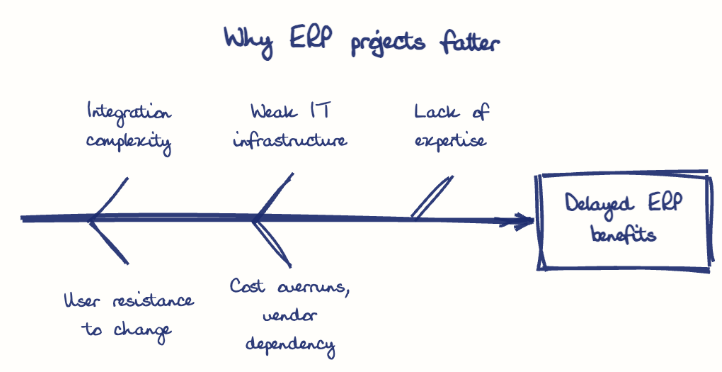
Enterprise Resource Planning is an integrated digital system that unifies an organisation's functions such as finance, operations and payroll on a single database, as in Andhra Pradesh's SAP-based CFMS. Critical execution issues include complex integration and customisation, user resistance to change, weak connectivity, and cost overruns with vendor dependence.
Model answer
Ghissu Editorial · Verified 4 Oct 2026 · 244 words
Customized ERP Development
The TISS-SVE ERP system integrates accounts, curricular content, and exams, managing complex multi-partner delivery models.
Centralized Data Management
Andhra Pradesh’s CFMS uses a single database for budget, treasury and accounts, enabling seamless data access and coordination across departments.
Stakeholder Role Definition
Clear access levels in TISS-SVE ERP separate supervisory roles between VAs and VMs, ensuring accountability.
Expert Involvement
Partnerships with professional ERP vendors address past public sector ERP failures.
Integration Complexity
Combining finance, operations, and content modules demands iterative customization and close IT-user collaboration.
Change Management
User resistance to legacy system replacement requires robust training and change frameworks.
Infrastructure Issues
Rural Andhra Pradesh faces connectivity challenges impacting real-time ERP data availability.
Cost and Maintenance
ERP projects often exceed budgets and need ongoing vendor support.
Strengthen IT Infrastructure
Expand reliable internet and data centers statewide.
Capacity Building
Specialized training to improve ERP literacy among government and partners.
Vendor Partnerships
Encourage source code handover and local maintenance for sustainability.
Change Management Frameworks
Institutionalize practices to overcome resistance and promote digital adoption.
This model answer is indicative and the model can make mistakes; please verify key facts independently.
Practise this question
1Get the answer sheet
Sized for this question.
2Write your answer
Timed, by hand.
3Get it marked
Your score and what to fix.
This chapter in the exam
Information and Communication Technology (ICT)24 questions
Asked in 8 of 8 sittings since 2008
Most tested: E-governance and digital public service delivery
- 2025Discuss the evolution of e-governance in India, highlighting key initiatives. Analyze how these initiatives have transformed public service delivery and enhanced citizen engagement.
- 2025Define cybercrime. Discuss the major types of cybercrimes prevalent in India today.
All 24 questions, sorted by sub-topic, with model answers and practice.
Question from the official APPSC Group-I Mains 2016 paper. Answer written by Ghissu's engine and checked against our editorial standards. Found an error? Tell us and we correct it within 48 hours.