What is 'Golden Rice'? Describe its advantages?
In short
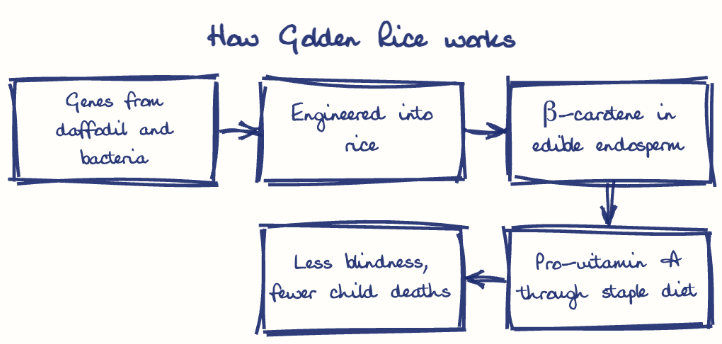
Golden Rice is a genetically modified rice engineered to produce pro-vitamin A (beta-carotene) in its edible grain, giving rice-dependent populations a staple-food remedy for vitamin A deficiency, blindness and child deaths. Developed by Ingo Potrykus and Peter Beyer, it was first approved for commercial cultivation by the Philippines in 2021.
Model answer
Ghissu Editorial · Verified 4 Oct 2026 · 335 words
Collaborative Innovation and Oversight
Developed by Professors Potrykus and Beyer with funding from the Rockefeller Foundation and EU, IRRI manages humanitarian oversight and safety, including a Humanitarian Board to ensure ethical deployment.
Complex Patent Landscape
Over 70 patents from 40 organizations were negotiated under a "freedom to operate" clause to enable free humanitarian use, overcoming initial intellectual property barriers.
Regulatory Approvals
Golden Rice is approved for food use in Australia, Canada and the US, and for cultivation only in the Philippines; India and Andhra Pradesh are still evaluating it amid biosafety concerns and public skepticism.
Biofortification and Adoption Challenges
First-generation Golden Rice had low β-carotene; newer generations improve nutrient content and consumer acceptance but face regulatory delays and GMO-related resistance, slowing farmer access.
Integration with Schemes
Once approved, distribute Golden Rice through the Public Distribution System and PM POSHAN school meals to enhance vitamin A intake in vulnerable populations.
Research and Development Support
Invest in R&D to further increase β-carotene levels, improve yield, and adapt varieties to local agro-climatic conditions for better adoption.
This model answer is indicative and the model can make mistakes; please verify key facts independently.
Sources
Practise this question
1Get the answer sheet
Sized for this question.
2Write your answer
Timed, by hand.
3Get it marked
Your score and what to fix.
This chapter in the exam
Human diseases; genetic engineering basics; biotechnology in agriculture; vaccines54 questions
Asked in 8 of 8 sittings since 2008
Most tested: Vaccines and immunisation, alongside GM crops/biotech agriculture.
- 2025Discuss the transmission dynamics of respiratory tract infections in densely populated urban settings. Propose effective public health strategies for their prevention.
- 2025Examine how urban infrastructure influences the implementation of preventive measures during microbial disease outbreaks. Suggest technology-driven solutions.
All 54 questions, sorted by sub-topic, with model answers and practice.
Question from the official APPSC Group-I Mains 2016 paper. Answer written by Ghissu's engine and checked against our editorial standards. Found an error? Tell us and we correct it within 48 hours.