What is immunisation? Briefly write the history of development of vaccines?
In short
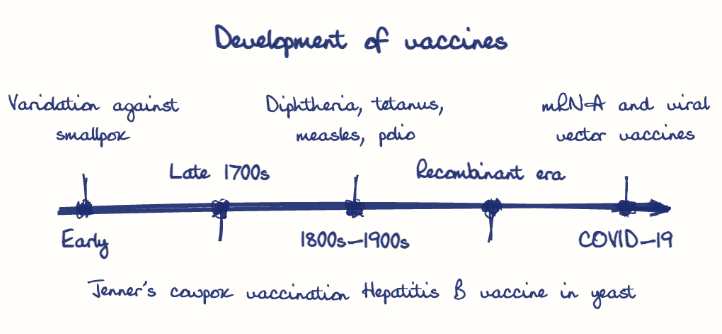
Immunisation makes a person resistant to an infectious disease, usually through a vaccine that creates immune memory for faster future responses. Vaccines evolved from Jenner's cowpox vaccination and Pasteur's rabies vaccine (1885) through BCG and the Salk and Sabin polio vaccines to smallpox eradication in 1980 and today's mRNA vaccines.
Model answer
Ghissu Editorial · Verified 4 Oct 2026 · 249 words
Public Health Significance
Immunisation fosters herd immunity, reducing transmission; programmes like the Universal Immunisation Programme have significantly increased vaccine coverage in India and Andhra Pradesh, protecting children and pregnant women from diseases such as polio, measles, and tetanus.
Jenner’s Discovery and Early Vaccination
Edward Jenner’s use of cowpox to prevent smallpox in the 18th century established vaccination’s foundation, coining the term ‘vaccination’ from ‘vaccinia’. Earlier practices like variolation also contributed to immunity development.
Technological Advances and Expanded Coverage
From diphtheria to polio vaccines, and modern recombinant DNA and mRNA technologies, vaccine development has evolved rapidly. India’s HPV vaccination drive1 targeting cervical cancer prevention2 exemplifies recent progress and expanded immunisation efforts.
Strengthening Local Vaccine Research
Enhancing R&D in Andhra Pradesh can foster indigenous vaccine development, reducing import dependence and promoting innovation.
Addressing Hesitancy and Expanding Outreach
Campaigns that address HPV vaccine hesitancy in rural India and integrate vaccination with awareness are vital to increase acceptance and achieve universal coverage.
This model answer is indicative and the model can make mistakes; please verify key facts independently.
Practise this question
1Get the answer sheet
Sized for this question.
2Write your answer
Timed, by hand.
3Get it marked
Your score and what to fix.
This chapter in the exam
Human diseases; genetic engineering basics; biotechnology in agriculture; vaccines54 questions
Asked in 8 of 8 sittings since 2008
Most tested: Vaccines and immunisation, alongside GM crops/biotech agriculture.
- 2025Discuss the transmission dynamics of respiratory tract infections in densely populated urban settings. Propose effective public health strategies for their prevention.
- 2025Examine how urban infrastructure influences the implementation of preventive measures during microbial disease outbreaks. Suggest technology-driven solutions.
All 54 questions, sorted by sub-topic, with model answers and practice.
Question from the official APPSC Group-I Mains 2016 paper. Answer written by Ghissu's engine and checked against our editorial standards. Found an error? Tell us and we correct it within 48 hours.