What is the cause of Chikungunya? What are its preventive measures and treatment? Give a comparative note on symptomology of Chikungunya and Dengue?
In short
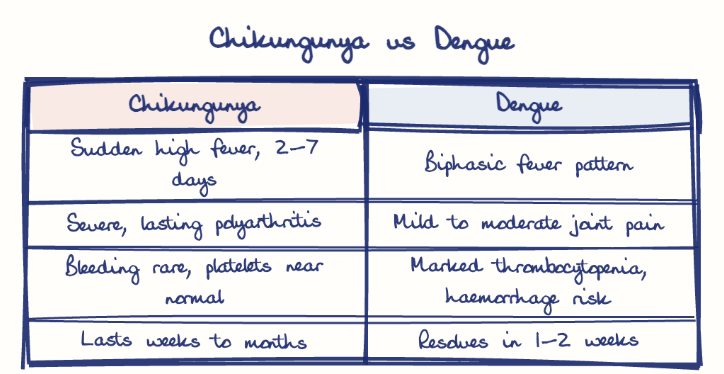
Chikungunya is caused by an alphavirus spread by Aedes mosquitoes, prevented by removing breeding sites and using nets and repellents, and treated only supportively with analgesics, fluids and rest. Unlike dengue, it causes severe, long-lasting joint pain, while dengue brings marked platelet fall and risk of haemorrhage and shock.
Model answer
Ghissu Editorial · Verified 4 Oct 2026 · 248 words
Viral Transmission
Chikungunya virus, an alphavirus, is transmitted by Aedes aegypti and Aedes albopictus mosquitoes breeding in stagnant water during monsoon seasons in Andhra Pradesh. These vectors are also responsible for Dengue, leading to overlapping outbreaks.
Vector Control and Personal Protection
Eliminating breeding sites, using mosquito nets and repellents, and community awareness campaigns are emphasized in Andhra Pradesh to reduce transmission. Public health drives promote wearing long-sleeved clothing and insecticide-treated nets during peak seasons.
Complications and Diagnosis
Dengue risks hemorrhagic fever and thrombocytopenia, rare in Chikungunya; overlapping symptoms necessitate laboratory confirmation, challenging in resource-limited Andhra Pradesh. Early differentiation is vital for appropriate treatment.
Surveillance and Healthcare Strengthening
Enhanced vector surveillance and improved diagnostic capacity under Integrated Disease Surveillance Programme (IDSP) are critical. Community engagement and addressing insecticide resistance will improve control.
Integrated Public Health Approach
Coordinated efforts involving urban planning, sanitation, and health education can reduce mosquito breeding and disease burden in vulnerable regions of Andhra Pradesh.
This model answer is indicative and the model can make mistakes; please verify key facts independently.
Practise this question
1Get the answer sheet
Sized for this question.
2Write your answer
Timed, by hand.
3Get it marked
Your score and what to fix.
This chapter in the exam
Human diseases; genetic engineering basics; biotechnology in agriculture; vaccines54 questions
Asked in 8 of 8 sittings since 2008
Most tested: Vaccines and immunisation, alongside GM crops/biotech agriculture.
- 2025Discuss the transmission dynamics of respiratory tract infections in densely populated urban settings. Propose effective public health strategies for their prevention.
- 2025Examine how urban infrastructure influences the implementation of preventive measures during microbial disease outbreaks. Suggest technology-driven solutions.
All 54 questions, sorted by sub-topic, with model answers and practice.
Question from the official APPSC Group-I Mains 2016 paper. Answer written by Ghissu's engine and checked against our editorial standards. Found an error? Tell us and we correct it within 48 hours.