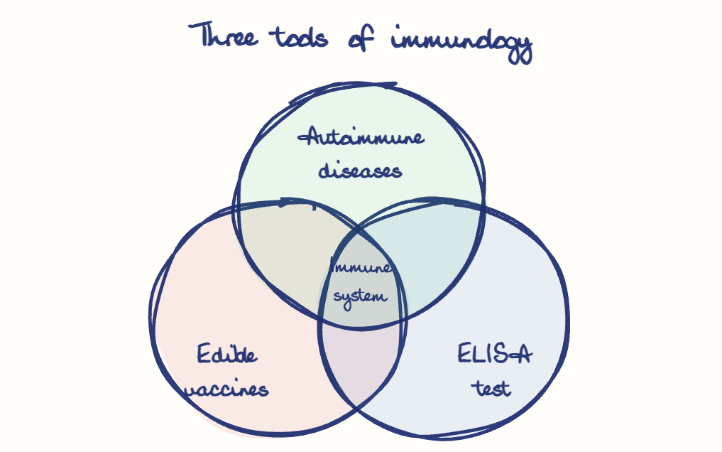
Write a short note on: (i) Edible vaccines (ii) ELISA test (iii) Autoimmune diseases
In short
Edible vaccines are genetically modified plants that produce antigenic proteins, offering cheap, easily distributed immunisation; ELISA is an enzyme-linked test detecting antibodies or antigens in blood to diagnose infections. Autoimmune diseases arise when the immune system attacks the body's own tissues, causing chronic disability that is often diagnosed late.
Model answer
Ghissu Editorial · Verified 4 Oct 2026 · 247 words
Edible Vaccines Development
Genetically modified plants producing antigenic proteins offer a cost-effective vaccine alternative; Andhra Pradesh research institutions linked to the Department of Biotechnology are advancing this technology.
ELISA Testing Infrastructure
ELISA is vital for detecting antibodies and antigens in infections and autoimmune diseases; ICMR’s regional centres in Andhra Pradesh facilitate widespread testing and surveillance.
Scalability and Acceptance Issues
Edible vaccines face dosage consistency, regulatory, and public acceptance challenges, especially in rural Andhra Pradesh where traditional vaccines dominate.
ELISA Accessibility
While ELISA tests are sensitive and cost-effective, rural outreach in Andhra Pradesh remains limited despite improvements in district hospitals.
Autoimmune Disease Management
Complex symptoms delay diagnosis; however, integration with national health missions in Andhra Pradesh is enhancing screening and treatment.
Enhance R&D and Infrastructure
Boost funding for edible vaccine research and expand ELISA testing networks in Andhra Pradesh, focusing on rural areas.
Public Awareness and Ethical Guidelines
Promote education on edible vaccines and autoimmune diseases, and establish ethical standards for biotechnology applications in Andhra Pradesh.
This model answer is indicative and the model can make mistakes; please verify key facts independently.
Practise this question
1Get the answer sheet
Sized for this question.
2Write your answer
Timed, by hand.
3Get it marked
Your score and what to fix.
This chapter in the exam
Biotechnology & Nanotechnology: scope, ethics, genetic engineering, biodiversity, fermentation, immuno-diagnosis50 questions
Asked in 8 of 8 sittings since 2008
Most tested: Biodiversity and biotechnology governance/ethics, especially conservation, GMOs, and applied public-health biotech.
- 2025Trace the evolution of India's National Biotechnology Development Strategy (NBDS) and discuss its key objectives. Critically evaluate its impact on the growth of the biotechnology sector in India.
- 2025Analyze the potential of plant-derived biopharmaceuticals in promoting sustainable healthcare. Explain how the application of green pharmacy principles can help minimize environmental harm at each stage of the pharmaceutical lifecycle.
All 50 questions, sorted by sub-topic, with model answers and practice.
Question from the official APPSC Group-I Mains 2016 paper. Answer written by Ghissu's engine and checked against our editorial standards. Found an error? Tell us and we correct it within 48 hours.