Write a short note on Shale Gas Revolution.
In short
The shale gas revolution is large-scale extraction of gas from shale rock through hydraulic fracturing and horizontal drilling, which raised US output from 3 to 70 billion cubic feet per day. India holds about 6.1 trillion cubic feet, but water use, pollution risks and pricing hold it back.
Model answer
Ghissu Editorial · Verified 4 Oct 2026 · 261 words
Technological Breakthrough
Hydraulic fracturing and horizontal drilling unlocked shale gas reserves, boosting US production from 3 to 70 billion cubic feet per day, as highlighted by the Senate Committee on Energy and Natural Resources.
India’s Shale Potential
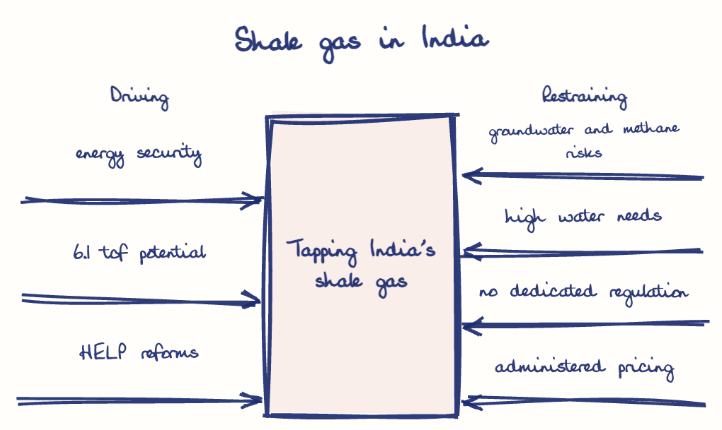
The USGS estimates 6.1 trillion cubic feet of shale gas in India’s basins, including Andhra Pradesh, with policies like NELP and HELP aiming to promote exploration.
Energy Security and Growth
Shale gas can reduce India’s LNG import dependence, stabilizing prices and supporting industrial growth in corridors like Visakhapatnam-Chennai, aligning with Make in India2 and Atmanirbhar Bharat initiatives.
Market and Infrastructure
Pricing reforms toward consumption-weighted baskets face challenges; expanding infrastructure in Andhra Pradesh is vital for cleaner fuel adoption.
Environmental Risks
Fracturing poses groundwater contamination and methane leakage risks, requiring robust safeguards, especially in water-scarce areas like Rayalaseema.
Regulatory and Economic Barriers
Lack of dedicated shale regulations and high exploration costs hinder investment, necessitating policy reforms.
Incentivize Exploration
Tailor contracts to local basins including Andhra Pradesh to encourage risk-taking.
Strengthen Environmental and Infrastructure Measures
Enhance monitoring and invest in water management and technology.
This model answer is indicative and the model can make mistakes; please verify key facts independently.
Practise this question
1Get the answer sheet
Sized for this question.
2Write your answer
Timed, by hand.
3Get it marked
Your score and what to fix.
This chapter in the exam
Energy: needs, resources, policy; Nuclear programme and policy24 questions
Asked in 8 of 8 sittings since 2008
Most tested: Renewable energy transition in India, especially solar/clean energy and barriers to large-scale adoption.
- 2025Differentiate between conventional and non-conventional energy resources. Explain their relevance in India's energy sector.
- 2023What is the current scenario of renewable power generation in India ? Discuss the factors responsible for the growing focus and shift towards Renewable energy.
All 24 questions, sorted by sub-topic, with model answers and practice.
Question from the official APPSC Group-I Mains 2016 paper. Answer written by Ghissu's engine and checked against our editorial standards. Found an error? Tell us and we correct it within 48 hours.