Write a short note on the following: (i) Homeostatis (ii) Animal response to Osmotic conditions of the medium
In short
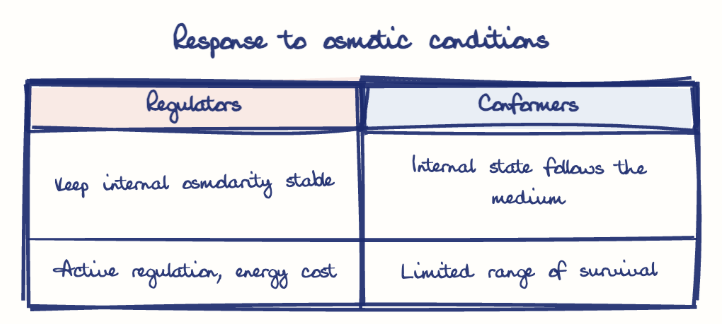
Homeostasis is the maintenance of a stable internal environment, such as temperature and osmotic concentration, despite external change, through thermoregulation and osmoregulation. Animals respond to osmotic conditions either as regulators that actively keep internal concentration stable at an energy cost, or as conformers whose internal state follows the medium.
Model answer
Ghissu Editorial · Verified 4 Oct 2026 · 256 words
Physiological Regulation Mechanisms
Walter Cannon’s concept of homeostasis explains how organisms regulate internal temperature and osmotic concentration, crucial for survival in Andhra Pradesh’s ecosystems. These processes include sweating, shivering, and osmoregulation to maintain fluid balance.
Research and Biodiversity Monitoring
Andhra Pradesh Biodiversity Board and Sri Venkateswara University study osmotic adaptations in aquatic fauna, informing conservation and fisheries management. Their work addresses salinity changes in coastal and estuarine zones.
Policy Frameworks
State water quality monitoring and pollution control programmes help maintain aquatic homeostasis by reducing pollution impacts, thereby supporting healthy osmotic environments for aquatic species.
Energetic Costs and Anthropogenic Impacts
Osmoregulation demands energy; pollution and habitat fragmentation near Visakhapatnam challenge species’ homeostasis and survival. Urbanization and industrial activities alter water quality, increasing osmotic stress.
Strengthen Research and Climate Resilience
Focus on osmotic regulation in aquatic ecosystems like Polavaram reservoir and integrate findings into climate adaptation plans for Krishna delta and Rayalaseema drought-prone areas.
Pollution Control and Community Engagement
Expand water quality monitoring and educate fishers and farmers on ecological balance to support homeostasis and sustainable livelihoods, enhancing resilience against osmotic stress.
This model answer is indicative and the model can make mistakes; please verify key facts independently.
Sources
Practise this question
1Get the answer sheet
Sized for this question.
2Write your answer
Timed, by hand.
3Get it marked
Your score and what to fix.
This chapter in the exam
Biotechnology & Nanotechnology: scope, ethics, genetic engineering, biodiversity, fermentation, immuno-diagnosis50 questions
Asked in 8 of 8 sittings since 2008
Most tested: Biodiversity and biotechnology governance/ethics, especially conservation, GMOs, and applied public-health biotech.
- 2025Trace the evolution of India's National Biotechnology Development Strategy (NBDS) and discuss its key objectives. Critically evaluate its impact on the growth of the biotechnology sector in India.
- 2025Analyze the potential of plant-derived biopharmaceuticals in promoting sustainable healthcare. Explain how the application of green pharmacy principles can help minimize environmental harm at each stage of the pharmaceutical lifecycle.
All 50 questions, sorted by sub-topic, with model answers and practice.
Question from the official APPSC Group-I Mains 2016 paper. Answer written by Ghissu's engine and checked against our editorial standards. Found an error? Tell us and we correct it within 48 hours.