Write a short note on the following: (i) Pyrolysis (ii) Incineration
In short
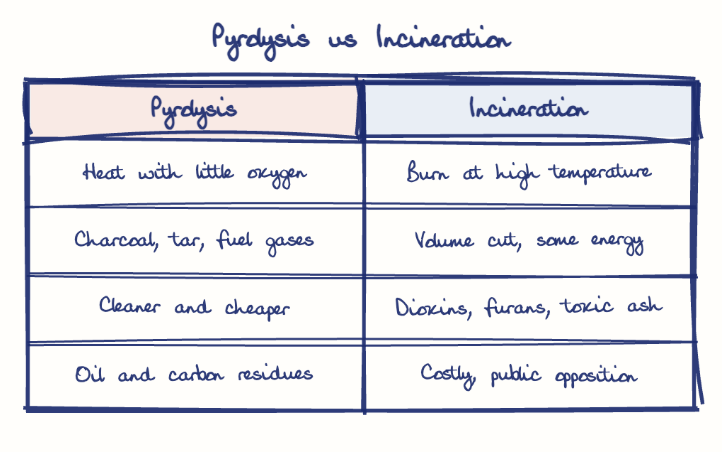
Pyrolysis is the thermal decomposition of waste in an oxygen-limited environment, yielding charcoal, tar and fuel gases with lower emissions. Incineration burns waste at high temperatures in excess air, cutting its volume by up to 90% but producing toxic ash, dioxins and furans that need strict emission control.
Model answer
Ghissu Editorial · Verified 4 Oct 2026 · 283 words
Regulatory Oversight
MoEFCC and CPCB set emission norms for pyrolysis and incineration, enforced by Andhra Pradesh Pollution Control Board, aligned with Solid Waste Management Rules, 2016 promoting waste-to-energy technologies in cities like Visakhapatnam and Vijayawada.
Operational Challenges
Urban local bodies in Andhra Pradesh often lack expertise and funds, affecting plant efficiency; PPP models have been used to improve management and compliance.
Pyrolysis and Incineration Impacts
Pyrolysis thermally decomposes waste in oxygen-limited conditions producing charcoal and fuel gases but leaves residues; incineration reduces waste volume but emits toxic ash and pollutants like dioxins, restricting its use mainly to biomedical waste and a few waste-to-energy plants, such as those near Guntur and Visakhapatnam.
Economic Viability and Waste Composition
Pyrolysis is cost-effective for agricultural residues in Rayalaseema but requires skilled operation; incineration is capital-intensive and faces public resistance; high organic waste content in Andhra Pradesh limits efficiency without segregation.
Technology Upgradation and Policy Support
Adoption of advanced pyrolysis with emission controls supports circular economy goals in Andhra Pradesh’s industrial corridors; national Waste-to-Energy guidelines encourage compliant plant setups.
Community Engagement and Monitoring
Awareness campaigns and strengthened monitoring by Andhra Pradesh Pollution Control Board are essential for safe and efficient thermal waste treatment.
Build capacity of local bodies for sustainable plant operation.
Enhance public awareness to foster acceptance.
This model answer is indicative and the model can make mistakes; please verify key facts independently.
Practise this question
1Get the answer sheet
Sized for this question.
2Write your answer
Timed, by hand.
3Get it marked
Your score and what to fix.
This chapter in the exam
Pollution & solid waste; global issues; environmental legislation; disaster management policy; agricultural revolutions43 questions
Asked in 8 of 8 sittings since 2008
Most tested: Solid waste management and pollution-control legislation
- 2025What are the key principles of Integrated Solid Waste Management (ISWM)? Discuss the role of waste hierarchy in ISWM.
- 2025Define global warming, and differentiate it clearly from climate change. Explain the key natural and human-induced causes of global warming and briefly discuss which factors are currently dominant in driving global temperature rise.
All 43 questions, sorted by sub-topic, with model answers and practice.
Question from the official APPSC Group-I Mains 2016 paper. Answer written by Ghissu's engine and checked against our editorial standards. Found an error? Tell us and we correct it within 48 hours.