Write the main points of the agreement reached at United Nations Climate Change Conference (COP 21) held at Paris in December, 2015. What was India's stand at the conference?
In short
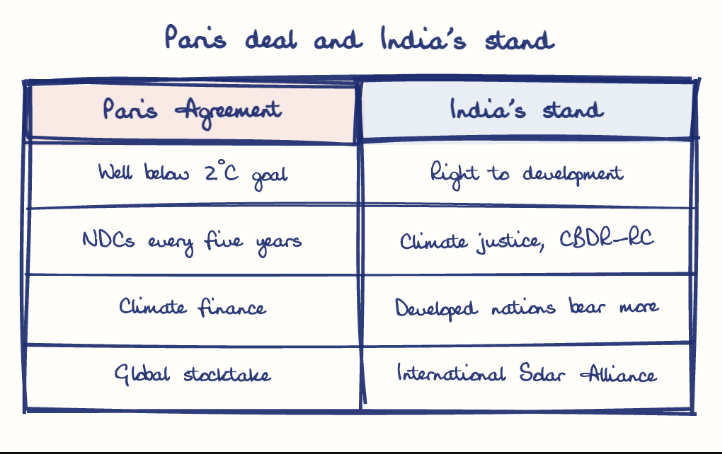
The Paris Agreement committed countries to keep warming well below 2°C, aiming for 1.5°C, through five-yearly NDCs, USD 100 billion a year in climate finance and a global stocktake. India championed climate justice and CBDR-RC, pledged a 33-35% cut in emissions intensity by 2030 and launched the International Solar Alliance.
Model answer
Ghissu Editorial · Verified 4 Oct 2026 · 248 words
NDCs and Climate Finance1
Countries submit updated NDCs every five years; developed nations committed USD 100 billion annually until 2025 to support developing countries, reflecting CBDR-RC principles. This financial support addresses equity and enables adaptation and mitigation efforts.
Sustainable Development Commitment
India ratified the Agreement in 2016, pledging a 33-35% reduction in emissions intensity by 2030 and 40% non-fossil fuel power capacity, balancing growth and climate goals. This reflects India’s focus on inclusive development alongside climate responsibility.
Renewable Energy Initiatives
India launched the International Solar Alliance and targeted 175 GW renewable capacity by 2022, with significant progress in Andhra Pradesh’s solar and wind projects. These efforts demonstrate India’s leadership in clean energy transition.
This model answer is indicative and the model can make mistakes; please verify key facts independently.
Practise this question
1Get the answer sheet
Sized for this question.
2Write your answer
Timed, by hand.
3Get it marked
Your score and what to fix.
This chapter in the exam
Pollution & solid waste; global issues; environmental legislation; disaster management policy; agricultural revolutions43 questions
Asked in 8 of 8 sittings since 2008
Most tested: Solid waste management and pollution-control legislation
- 2025What are the key principles of Integrated Solid Waste Management (ISWM)? Discuss the role of waste hierarchy in ISWM.
- 2025Define global warming, and differentiate it clearly from climate change. Explain the key natural and human-induced causes of global warming and briefly discuss which factors are currently dominant in driving global temperature rise.
All 43 questions, sorted by sub-topic, with model answers and practice.
Question from the official APPSC Group-I Mains 2016 paper. Answer written by Ghissu's engine and checked against our editorial standards. Found an error? Tell us and we correct it within 48 hours.