Critically analyse the growth of Telugu language and literature between 1000 AD and 1500 AD.
In short
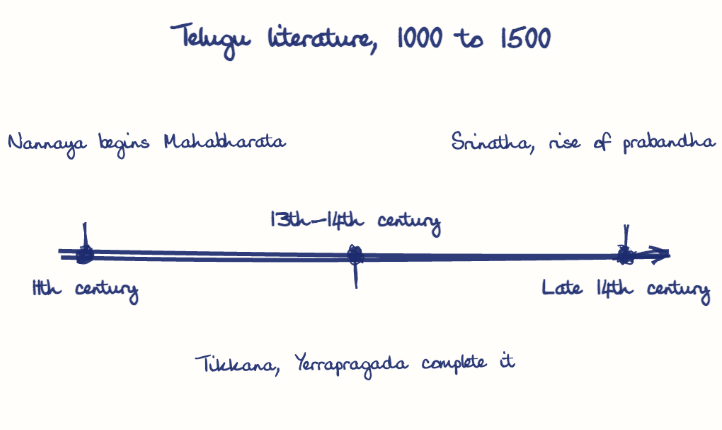
Between 1000 and 1500 AD Telugu grew from Nannaya's Mahabharata under Raja Raja Narendra, completed by Tikkana and Yerrapragada (the Kavitraya), to Srinatha's original poetry and the prabandha form under Kakatiya and Vijayanagara patronage. Yet growth was shaped by Sanskrit dominance, translation-heavy output and an elite courtly orientation.
Model answer
Ghissu Editorial · Verified 4 Oct 2026 · 261 words
Nannaya’s Literary Foundation
Nannaya, under Raja Raja Narendra of Rajahmahendravaram, initiated Telugu’s classical form by translating the Mahabharata, blending Sanskrit metres with Telugu vocabulary. His pioneering work set the poetic style and linguistic framework for future literature.
Royal Patronage
Kakatiya and Vijayanagara rulers institutionalized Telugu through administrative use and literary patronage, with Sri Krishna Deva Raya’s Ashtadiggajas marking a golden age. This patronage elevated Telugu’s status and encouraged literary excellence.
Epic and Devotional Works
Translations of Sanskrit epics and original Shaivite and Vaishnavite texts like Basava Purana reflected Bhakti influence in Andhra Pradesh. These works combined religious devotion with literary innovation, broadening Telugu’s thematic scope.
Original Poetry and Prabandhas
Poets like Srinatha advanced original Telugu poetry and prabandha narratives, blending history and literary grandeur. Srinatha’s *Palnati Veera Charitra* exemplifies this fusion of historical narrative and poetic artistry.
Political and Religious Support
Royal patronage and the Bhakti movement boosted literary production, making Telugu a vehicle for both administration and spiritual expression. The Vijayanagara Empire’s cultural milieu was especially conducive to literary growth.
This model answer is indicative and the model can make mistakes; please verify key facts independently.
Practise this question
1Get the answer sheet
Sized for this question.
2Write your answer
Timed, by hand.
3Get it marked
Your score and what to fix.
This chapter in the exam
Andhra - Medieval16 questions
Asked in 8 of 8 sittings since 2008
Most tested: Telugu language and literature under medieval dynasties, especially Kakatiya, Qutub Shahi, Reddi, and Vijayanagara patronage.
- 2025Discuss the growth of various Saivite sects during the Kakatiya rule.
- 2025Discuss the significance of the Warangal Fort complex as a historical monument.
All 16 questions, sorted by sub-topic, with model answers and practice.
Question from the official APPSC Group-I Mains 2017 paper. Answer written by Ghissu's engine and checked against our editorial standards. Found an error? Tell us and we correct it within 48 hours.