Critically examine the objectives and results of the movement of Tripuraneni Ramaswamy Chowdary.
In short
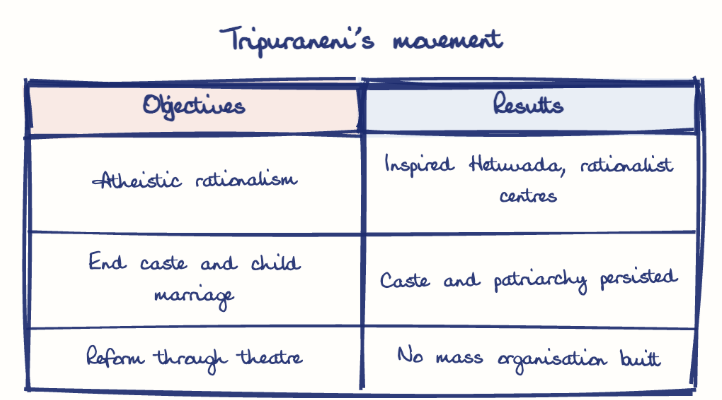
Tripuraneni Ramaswamy Chowdary's rationalist movement sought to free society from religious dogma, caste discrimination and child marriage, through works like Sambuka Vadha and the priestless marriage manual Vivaha Vidhi. Orthodox resistance and weak organisation limited its results, but it shaped later Andhra rationalism, including Vijayawada's Atheist Centre.
Model answer
Ghissu Editorial · Verified 4 Oct 2026 · 276 words
Rationalist Ideology
Grounded in atheistic rationalism, Tripuraneni’s writings like *Brahma Bhagvadgita* and *Sambuka Vadha* rejected Hindu orthodoxy to promote scientific temper and liberate society from dogma.
Social Reform Agenda
He targeted child marriage, widow remarriage, women’s education, and caste discrimination, aligning with but radicalizing the Andhra Renaissance by directly confronting religious orthodoxy.
Resistance and Limited Mobilization
Orthodox caste groups and religious authorities opposed his atheism and reforms, viewing them as threats to traditional power. The movement’s lack of formal organization limited mass impact compared to contemporaries like Kandukuri Viresalingam.
Enduring Influence
His critique of caste and religion fed the rationalist climate in which the Atheist Centre at Vijayawada and publications like *Hetuvada* took root, contributing to gradual social change despite limited immediate success.
Institutional Strengthening and Education
Formal organizations to carry forward Tripuraneni’s ideals and integrating rationalist thought into school and college curricula can deepen reform impact and nurture critical thinking.
Cultural and Welfare Linkages
Expanding theatre, literature, and digital media use, along with aligning reform efforts with welfare schemes like Telangana's Indiramma Indlu1 and Mahalakshmi, can address socio-economic barriers to women’s empowerment and social justice.
This model answer is indicative and the model can make mistakes; please verify key facts independently.
Practise this question
1Get the answer sheet
Sized for this question.
2Write your answer
Timed, by hand.
3Get it marked
Your score and what to fix.
This chapter in the exam
Andhra - Nationalist Movement and Formation of the State22 questions
Asked in 8 of 8 sittings since 2008
Most tested: Formation of Andhra Pradesh and the Andhra-Telangana statehood process
- 2025What were the provisions of the Gentlemen's Agreement of 1956? How far could they satisfy apprehensions of the Telangana region?
- 2025Outline the role of the students in raising major issues in the 1969 Telangana agitation.
All 22 questions, sorted by sub-topic, with model answers and practice.
Question from the official APPSC Group-I Mains 2017 paper. Answer written by Ghissu's engine and checked against our editorial standards. Found an error? Tell us and we correct it within 48 hours.