Explain in what respects the Harappan civilization differed from that of the later Vedic civilization.
In short
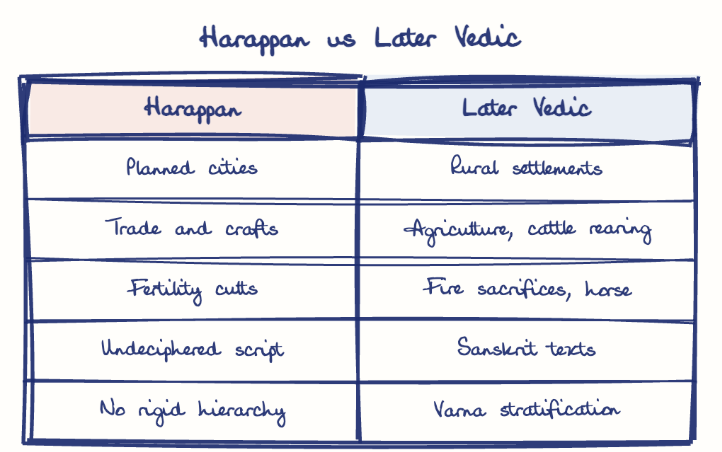
The Harappan civilization was urban, trade-oriented and craft-based, with planned cities, no evident priestly or warrior rule and an undeciphered script, while the later Vedic civilization was rural and agrarian, monarchical, varna-stratified and centred on fire sacrifices. Vedic society used iron tools and composed Sanskrit texts like the Brahmanas.
Model answer
Ghissu Editorial · Verified 4 Oct 2026 · 248 words
Urbanism and Economy
Harappans built well-planned cities like Mohenjo-daro with advanced drainage and engaged in maritime trade with Mesopotamia; later Vedic society was rural, relying on agriculture, cattle rearing, iron tools and Painted Grey Ware pottery.
Political and Social Organization
Harappan polity likely involved merchant oligarchies without warrior or priestly dominance; Vedic civilization featured monarchical rule supported by Brahmin priests and a rigid Varna system.
Religious Practices
Harappan religion focused on fertility cults and animal motifs, with fire altars at only a few sites and no horse symbolism; later Vedic religion emphasized elaborate fire sacrifices (yajnas) such as the Ashvamedha, with Prajapati, Vishnu and Rudra rising in importance.
Language and Texts
The Harappan script remains undeciphered, while the Vedic texts were composed in early Indo-Aryan Sanskrit, marking a clear linguistic shift.
Technology and Continuity
Harappans used copper and bronze, while later Vedic society used iron; separated by centuries, Harappan urbanism did not directly continue into the Vedic period.
Research and Preservation
Promoting interdisciplinary research and conserving sites like Dholavira are vital for deeper understanding.
This model answer is indicative and the model can make mistakes; please verify key facts independently.
Sources
Practise this question
1Get the answer sheet
Sized for this question.
2Write your answer
Timed, by hand.
3Get it marked
Your score and what to fix.
This chapter in the exam
Ancient India - Pre-history, IVC, Vedic, Mauryas, Kushans, Satavahanas, Sangam, Guptas16 questions
Asked in 8 of 8 sittings since 2008
Most tested: Harappan civilisation—urban planning, origin/decline, and continuity.
- 2025Discuss the origin and expansion of the Indus Valley Civilization.
- 2025Briefly analyze the teachings of Buddha and Mahavira.
All 16 questions, sorted by sub-topic, with model answers and practice.
Question from the official APPSC Group-I Mains 2017 paper. Answer written by Ghissu's engine and checked against our editorial standards. Found an error? Tell us and we correct it within 48 hours.