What do you know about Sangam age ? How does Sangam age literature help us in knowing the political and cultural life of that age ?
In short
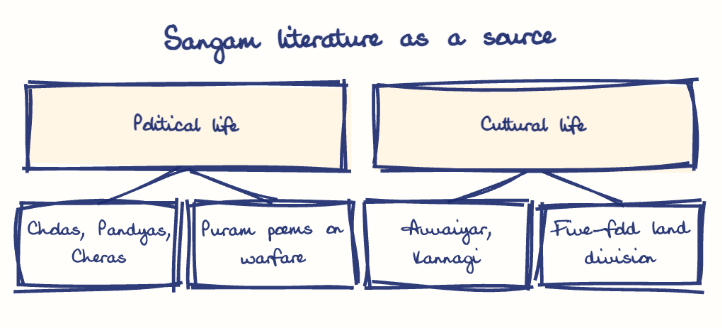
The Sangam Age (about 300 BCE to 300 CE) was the period when assemblies of Tamil poets produced literature under Chola, Pandya and Chera patronage. Its Puram poems and Tolkappiyam reveal monarchy, warfare and social order, while the five-fold land classification, Murugan worship and poets like Avvaiyar reveal culture.
Model answer
Ghissu Editorial · Verified 4 Oct 2026 · 260 words
Three Kingdoms Rule
The Cholas, Pandyas, and Cheras were hereditary monarchies supporting Sangam poets and arts, each maintaining distinct political identities and territorial control.
Social Stratification and Gender Roles
Society had caste divisions; women like poet Avvaiyar contributed to literature; love marriages and chastity were valued, exemplified by the heroine Kannagi’s story.
Religious Practices
Polytheism centered on Murugan and Mayon, with festivals, rituals, and temples integral to cultural identity1 and daily life.
Artistic Expressions
Poetry, music, and dance flourished, with vivid descriptions of festivals and heroic memorials reflecting a vibrant cultural milieu.
Land Classification and Economy
Five-fold land types (kurinji, mullai, marudam, neithal, palai) linked geography to economic roles and deities, shaping social organization and livelihoods.
Kashi Tamil Sangamam2
promotes Tamil literary studies bridging tradition and modernity, fostering deeper engagement with Sangam heritage.
Educational Integration
Incorporate Sangam literature in curricula to preserve heritage and enhance understanding of India’s ancient regional histories.
This model answer is indicative and the model can make mistakes; please verify key facts independently.
Practise this question
1Get the answer sheet
Sized for this question.
2Write your answer
Timed, by hand.
3Get it marked
Your score and what to fix.
This chapter in the exam
Ancient India - Pre-history, IVC, Vedic, Mauryas, Kushans, Satavahanas, Sangam, Guptas16 questions
Asked in 8 of 8 sittings since 2008
Most tested: Harappan civilisation—urban planning, origin/decline, and continuity.
- 2025Discuss the origin and expansion of the Indus Valley Civilization.
- 2025Briefly analyze the teachings of Buddha and Mahavira.
All 16 questions, sorted by sub-topic, with model answers and practice.
Question from the official APPSC Group-I Mains 2017 paper. Answer written by Ghissu's engine and checked against our editorial standards. Found an error? Tell us and we correct it within 48 hours.