The Indian Constitution provides for a democratic system in India. In this backdrop, briefly analyse the constitutional provisions with regard to tyranny of majority and appeasement of minority.
In short
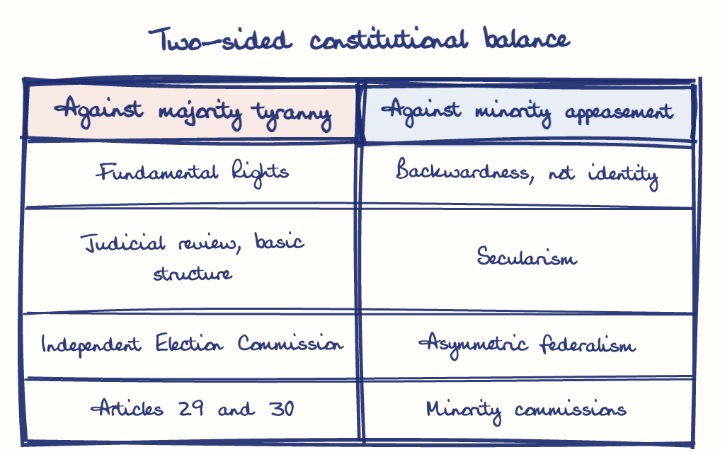
The Constitution checks majority tyranny through enforceable Fundamental Rights, judicial review, an independent Election Commission and minority rights under Articles 29 and 30, while avoiding appeasement by grounding special provisions in backwardness and secular equality. The Kesavananda Bharati basic structure doctrine bars majorities from amending away core rights.
Model answer
Ghissu Editorial · Verified 4 Oct 2026 · 285 words
Judicial Review and Basic Structure Doctrine
The Kesavananda Bharati judgment empowers the Supreme Court to strike down laws violating fundamental rights or the Constitution’s basic structure, preventing tyranny.
Independent Election Commission
Articles 324-327 establish an autonomous Election Commission that ensures free and fair elections, preventing manipulation by dominant groups and protecting minority representation.
Reservation and Special Protections
Articles 15(4) and 16(4) allow affirmative action for Scheduled Castes, Scheduled Tribes, and minorities, promoting social justice without undermining meritocracy.
Minority Commissions and Regional Autonomy
Bodies like the National Commission for Minorities and provisions such as Article 371 address minority grievances and regional concerns (Article 371D, for instance, protects regional equity in jobs and education in Andhra Pradesh), ensuring their concerns are heard within the democratic framework.
Democratic Representation with Judicial Oversight
Universal franchise enables majority rule, but constitutional morality and courts protect minorities from majoritarian excesses.
Federalism and Decentralization
Panchayati Raj institutions empower minorities locally, reducing alienation and enabling participation in governance.
Strengthen Judicial Capacity and Inclusive Politics
Enhance courts’ infrastructure and training to protect minority rights effectively and promote inclusive political dialogue, especially in Andhra Pradesh.
Empower Local Governance and Education
Deepen decentralization through Panchayati Raj and implement constitutional literacy programs to foster understanding and reduce communal tensions.
This model answer is indicative and the model can make mistakes; please verify key facts independently.
Sources
Practise this question
1Get the answer sheet
Sized for this question.
2Write your answer
Timed, by hand.
3Get it marked
Your score and what to fix.
This chapter in the exam
Indian Constitution, Fundamental Rights, DPSP and Union-State functions18 questions
Asked in 8 of 8 sittings since 2008
Most tested: Rights, social justice, and constitutional safeguards for disadvantaged groups.
- 2025The Indian Constitution favours a federal type of government. Considering this, what duties does the Constitution place on State Governments to ensure the smooth functioning of the nation?
- 2025The Constitution of India grants certain rights to citizens and also provides measures to safeguard them. What are the key constitutional arrangements to ensure the protection of these rights?
All 18 questions, sorted by sub-topic, with model answers and practice.
Question from the official APPSC Group-I Mains 2017 paper. Answer written by Ghissu's engine and checked against our editorial standards. Found an error? Tell us and we correct it within 48 hours.