"The Right to Information Act is meant only for providing information but not grievance redressal." Comment.
In short
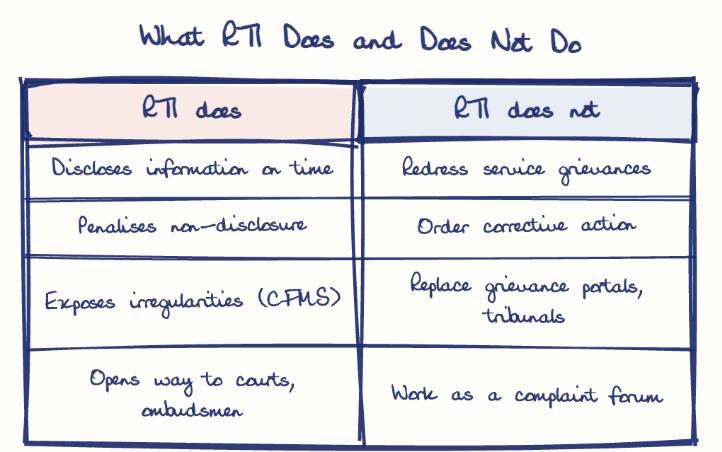
The statement is largely correct in law: the RTI Act is an instrument of disclosure, and Information Commissions can penalise officials for withholding information but cannot redress service grievances. Yet information is often the first step to justice, equipping citizens to seek remedies through courts, ombudsmen and administrative tribunals.
Model answer
Ghissu Editorial · Verified 4 Oct 2026 · 276 words
Transparency and Accountability Mandate
The RTI Act mandates proactive disclosure by public authorities, covering all constitutional bodies, to ensure government accountability. It establishes Public Information Officers and Information Commissions to facilitate information access and adjudicate disputes related to information requests.
Empowerment through Information Access
Andhra Pradesh2’s CAG audit revealed ₹968 crore excess payments, findings that citizens can pursue through RTI, demonstrating its role in exposing corruption and empowering citizens. This access enables marginalized groups to participate meaningfully in democracy and demand better governance.
RTI as Information Tool, Not Complaint Forum
The Act provides a legal right to information but does not establish grievance redressal; Information Commissions cannot adjudicate service-related complaints or enforce corrective action.
Focus on Transparency Strengthens Democracy
Limiting RTI to information provision preserves its clarity and legal enforceability, avoiding administrative overload and legal ambiguity, thus maintaining transparency as the cornerstone of citizen empowerment.
Need for Complementary Mechanisms
Robust grievance redressal systems like Andhra Pradesh’s public grievance cell are necessary to complement RTI’s transparency. Such mechanisms ensure that citizens’ complaints are addressed effectively alongside information access.
This model answer is indicative and the model can make mistakes; please verify key facts independently.
Practise this question
1Get the answer sheet
Sized for this question.
2Write your answer
Timed, by hand.
3Get it marked
Your score and what to fix.
This chapter in the exam
Good governance, e-governance, RTI and Social Audit8 questions
Asked in 4 of 8 sittings since 2008
Most tested: RTI as a transparency and accountability instrument within good governance
- 2025Define good governance. How does the Right to Information (RTI) Act promote the principles of good governance in India?
- 2025Social audit helps to narrow gaps between vision and reality. Examine the statement and also discuss the impediments in the institutionalisation of social audit in India.
All 8 questions, sorted by sub-topic, with model answers and practice.
Question from the official APPSC Group-I Mains 2017 paper. Answer written by Ghissu's engine and checked against our editorial standards. Found an error? Tell us and we correct it within 48 hours.