Critically evaluate the nature of occupational structure in Andhra Pradesh.
In short
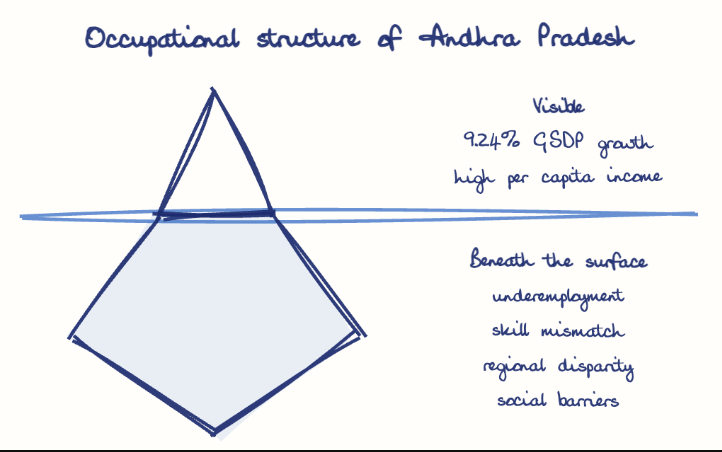
Andhra Pradesh's occupational structure is in transition: agriculture still employs a large share of workers, while industry and services grow through port-led corridors and knowledge-intensive jobs. The shift is uneven, with farm underemployment, skill gaps, weak SPSE governance and lagging Rayalaseema, while urban population reached about 30% in 2011.
Model answer
Ghissu Editorial · Verified 4 Oct 2026 · 253 words
Agricultural Significance
Agriculture remains vital, contributing ₹2.32 lakh crore to GVA with 10.70% growth in 2024-25, supported by APCNF and Annadatha Sukhibhava Scheme, despite water disputes and drought in Rayalaseema.
Industrial and Service Expansion
Industrial growth leverages port-led corridors and SPSEs (6.69% of GSDP), though governance issues persist; service sector growth is driven by knowledge hubs and schemes like Samagra Shiksha Abhiyan and ULLAS.
Skill and Infrastructure Gaps
Education and health sectors face vacancies and infrastructure shortfalls (flagged for health infrastructure3 by the CAG in 2024), limiting skilled employment growth.
Social and Regional Disparities
Improved literacy and sex ratio aid mobility, but caste and regional inequalities, especially in Rayalaseema, restrict occupational access.
Employment Quality and Sustainability
Large agricultural workforce faces underemployment; welfare fund diversion and poor solid waste management in urban local bodies (flagged in audits of Andhra Pradesh4) threaten sustainability.
Governance and Economic Balance
SPSE arrears and governance issues constrain industrial potential, requiring reforms to harness port-led corridors fully.
Policy Focus
Enhance climate-resilient farming under APCNF, reform SPSE governance, fill vacancies in health and education, and promote balanced regional development to reduce disparities.
This model answer is indicative and the model can make mistakes; please verify key facts independently.
Practise this question
1Get the answer sheet
Sized for this question.
2Write your answer
Timed, by hand.
3Get it marked
Your score and what to fix.
This chapter in the exam
Agriculture Development in Andhra Pradesh31 questions
Asked in 8 of 8 sittings since 2008
Most tested: Agriculture’s structure, performance, and state policy interventions in Andhra Pradesh.
- 2025Discuss the role of agriculture in the economic development of Andhra Pradesh. How has agriculture contributed to the State Gross Domestic Product (SGDP) in recent years? Identify the key drivers influencing its performance.
- 2025What are the key drivers for the growth of the fisheries sector? What are the schemes undertaken by the fisheries department for the growth of this sector?
All 31 questions, sorted by sub-topic, with model answers and practice.
Question from the official APPSC Group-I Mains 2017 paper. Answer written by Ghissu's engine and checked against our editorial standards. Found an error? Tell us and we correct it within 48 hours.