Describe the salient features of National Manufacturing Policy and also the critical role of manufacturing sector in employment generation.
In short
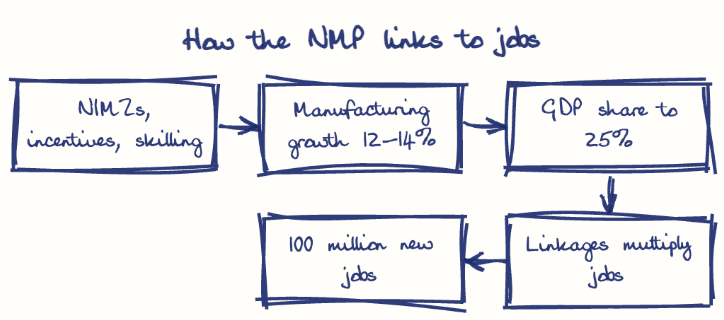
The National Manufacturing Policy (2011) aimed for 12-14% manufacturing growth, a 25% GDP share and 100 million new jobs by 2022, through National Investment and Manufacturing Zones, sectoral focus and skill development. Manufacturing is critical for employment because it absorbs semi-skilled labour, sustains MSMEs and creates multiplier linkages.
Model answer
Ghissu Editorial · Verified 4 Oct 2026 · 266 words
Ambitious Growth and Employment Goals
NMP targets 12-14% manufacturing growth and 25% GDP contribution by 2022, aiming to create 100 million jobs, focusing on skill development for inclusive growth.
National Investment and Manufacturing Zones (NIMZs)
Large industrial townships of 5000+ hectares developed via public-private partnerships, with central government funding infrastructure and states providing land, fostering competitive manufacturing hubs.
MSMEs and Skill Development
MSMEs contribute over 35% of output and are employment-intensive; schemes like Skill India and EPFO incentives encourage formal employment and skill upgradation, as seen in Andhra Pradesh’s industrial parks.
Linkages and Policy Initiatives
Manufacturing creates multiplier effects through upstream and downstream linkages, exemplified by Andhra Pradesh’s port-led corridors; PLI and PM MITRA parks4 promote labour-intensive and high-tech manufacturing to counter automation challenges.
Strengthen NIMZs and MSME Support
Accelerate NIMZ development with state participation and enhance MSME credit and technology access to boost employment.
Focus on Skill Ecosystems and Labour-Intensive Sectors
Integrate vocational training with industry needs and promote sectors like textiles and electronics assembly through incentives.
This model answer is indicative and the model can make mistakes; please verify key facts independently.
Practise this question
1Get the answer sheet
Sized for this question.
2Write your answer
Timed, by hand.
3Get it marked
Your score and what to fix.
This chapter in the exam
Industrial Development and Policy (India)12 questions
Asked in 5 of 8 sittings since 2008
Most tested: Manufacturing-led industrial policy reform and its policy instruments.
- 2025Discuss the role of the industrial sector in the economic development of India. Discuss the role of the Department of Industrial Policy & Promotion (DIPP).
- 2025Examine the role of the industrial sector in India's economic development. How does industrialisation contribute to income generation, employment, and modernisation of the economy? Support your answer with relevant examples and policy references.
All 12 questions, sorted by sub-topic, with model answers and practice.
Question from the official APPSC Group-I Mains 2017 paper. Answer written by Ghissu's engine and checked against our editorial standards. Found an error? Tell us and we correct it within 48 hours.