Discuss the nature and importance of Public-Private Partnership (PPP) in health care and basic education in India.
In short
PPPs in health care and basic education combine public goals and funding with private efficiency and innovation, helping bridge fiscal and infrastructure gaps. Their success depends on clear contracts, risk sharing and state capacity, which remain weak, as Andhra Pradesh's 175 Community Health Centres against 412 required show.
Model answer
Ghissu Editorial · Verified 4 Oct 2026 · 268 words
Policy and Legal Foundations
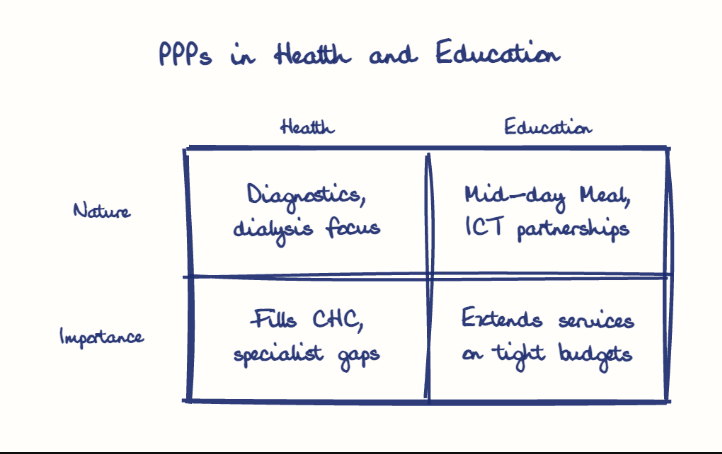
India lacks a uniform PPP policy; Andhra Pradesh invests Rs. 1069 crores in education PPPs including Mid-day Meal and ICT schemes, showing commitment despite governance issues. The absence of a national framework leads to varied state approaches and inconsistent outcomes.
Capacity Constraints
Andhra Pradesh faces 22% specialist and 21% nurse vacancies, limiting effective PPP management and monitoring. This shortage hampers contract design, performance evaluation, and beneficiary identification, weakening accountability and service quality.
Service Delivery Gaps
PPPs focus on diagnostics and dialysis; Andhra Pradesh has only 175 Community Health Centres2 versus 412 required (CAG 2024), highlighting persistent access shortfalls. Limited scope and risk aversion restrict PPPs from addressing broader primary health care needs.
Equity and Affordability
Private medical education3 PPPs create an access vs. affordability dilemma, risking exclusion of marginalized groups. Without subsidies or cross-subsidization, PPPs may exacerbate inequalities, undermining inclusive development goals.
State-specific Innovations
Support pilots in states like Andhra Pradesh addressing local infrastructure and human resource gaps, leveraging successful models from Maharashtra and others.
This model answer is indicative and the model can make mistakes; please verify key facts independently.
Practise this question
1Get the answer sheet
Sized for this question.
2Write your answer
Timed, by hand.
3Get it marked
Your score and what to fix.
This chapter in the exam
Inclusive Growth: India and AP schemes49 questions
Asked in 8 of 8 sittings since 2008
Most tested: Women empowerment and poverty reduction through AP welfare and credit-linked institutions
- 2025Elaborate on the meaning of Inclusive Growth in the context of the Indian economy. Discuss the key strategies and instruments that can be employed to foster greater inclusion and ensure that the benefits of economic growth reach all sections of society.
- 2025Critically Examine the major poverty alleviation and employment generation programmes in India. How effective have they been in addressing rural and urban poverty?
All 49 questions, sorted by sub-topic, with model answers and practice.
Question from the official APPSC Group-I Mains 2017 paper. Answer written by Ghissu's engine and checked against our editorial standards. Found an error? Tell us and we correct it within 48 hours.