Discuss the nature of sectoral contribution of income to national income of India since independence. Also Examine whether the changes in sectoral contribution to national income of India followed Kuznets-Clark hypothesis.
In short
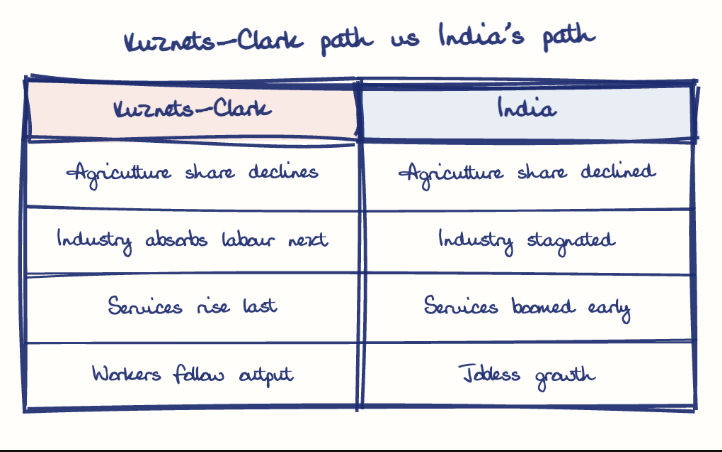
Agriculture's share of national income fell from nearly half at independence to about 15.2% in 2023-24, while industry stagnated near a quarter and services passed half. This only partly fits the Kuznets-Clark hypothesis: India skipped strong industrialisation, moving to services in a premature tertiarisation.
Model answer
Ghissu Editorial · Verified 4 Oct 2026 · 259 words
Agriculture’s Early Dominance
Agriculture contributed nearly 50% of national income at independence, mirrored in Andhra Pradesh3’s rural economy, reflecting a predominantly agrarian structure.
Industrial Sector’s Modest Share
Industry accounted for about one-sixth of income, constrained by the license-raj; Visakhapatnam port and industrial corridors in Andhra Pradesh supported regional industrial growth.
Decline in Agriculture’s Share
Agriculture’s share fell from over 50% in the early 1950s to 15.2%4 in 2023-24, but employment remains high at 46.1%, indicating low productivity, seen also in Rayalaseema.
Stagnant Industrial Growth
Industrial share stagnated around 15-16%, showing “premature deindustrialization,” despite Andhra Pradesh’s capital goods sector growth under the National Capital Goods Policy.
Rapid Services Expansion
Services now contribute over half of Gross Value Added5, boosted by liberalization and digital infrastructure like UPI and DBT; Andhra Pradesh’s service sector outpaces national averages.
Partial Conformity and Premature Tertiarisation
India shows agriculture decline and services growth but weak industrial expansion, deviating from Kuznets-Clark’s sequential model.
Sustainability Concerns
High agricultural employment and jobless growth raise questions about inclusive and sustainable development.
This model answer is indicative and the model can make mistakes; please verify key facts independently.
Practise this question
1Get the answer sheet
Sized for this question.
2Write your answer
Timed, by hand.
3Get it marked
Your score and what to fix.
This chapter in the exam
Major Challenges of Indian Economy26 questions
Asked in 8 of 8 sittings since 2008
Most tested: Unemployment and employment structure
- 2025Discuss how infrastructure bottlenecks hinder the growth of the Indian Manufacturing sector. What steps can be taken to address them?
- 2025Analyse the factors contributing to India's Current Account Deficit (CAD) and unfavourable Balance of Payments (BoP) and discuss their implications for the Indian economy.
All 26 questions, sorted by sub-topic, with model answers and practice.
Question from the official APPSC Group-I Mains 2017 paper. Answer written by Ghissu's engine and checked against our editorial standards. Found an error? Tell us and we correct it within 48 hours.