Evaluate the trends in output and productivity of food and non-food crops in Andhra Pradesh (in the present 13 districts) since the year 2000 – 01. Also bring out the reasons for regional variations in productivity levels.
In short
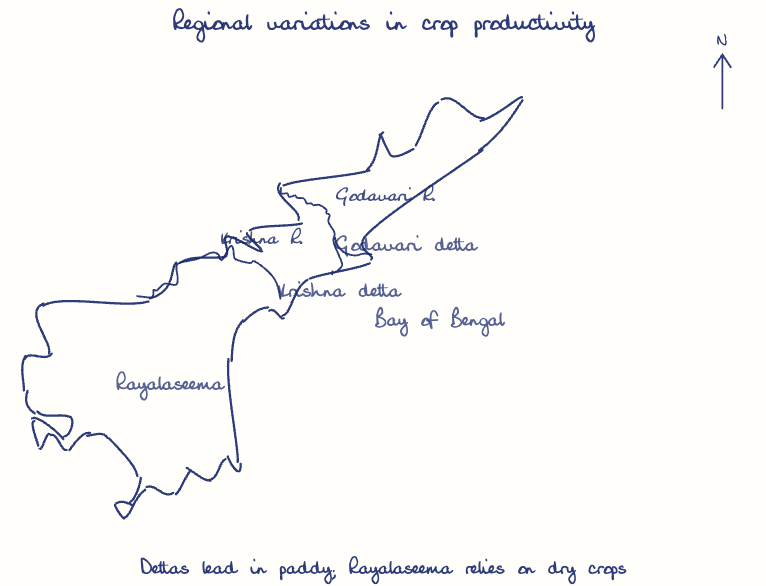
Since 2000-01, Andhra Pradesh has raised food and non-food crop output through diversification into horticulture, chilli and aquaculture, but productivity varies regionally due to uneven irrigation, soil health, credit access and climate risk. Irrigated Krishna and East Godavari lead in paddy, while drought-prone Rayalaseema relies on groundnut.
Model answer
Ghissu Editorial · Verified 4 Oct 2026 · 288 words
Robust Crop Diversification
Andhra Pradesh shows strong growth in food and non-food crops, with horticulture, chilli, and aquaculture contributing to a 10.70% agricultural GVA growth in 2024-25. This diversification has helped reduce dependence on staple grains and increased farmers’ income.
Technological Initiatives and Improved Productivity
Programs like AP Community Managed Natural Farming (APCNF) and soil health cards promote sustainable farming and improved yields. The state also ranks among the top three nationally in aggregate land productivity, reflecting efficient resource use despite lower irrigation coverage than Punjab and Haryana.
Irrigation and Water Stress
Rayalaseema’s limited irrigation infrastructure and groundwater depletion hinder productivity compared to coastal districts like Krishna and East Godavari, which benefit from fertile soils and better water availability.
Irrigation Expansion and Crop Intensification
Projects like Polavaram irrigation and promotion of micro-irrigation techniques can boost water availability in drought-prone areas, enhancing cropping intensity2 and yields.
Institutional Support and Sustainable Practices
Strengthening Farmer Producer Organisations (FPOs) will improve market access and bargaining power for smallholders. Scaling the Soil Health Card Scheme and natural farming initiatives will restore soil fertility and reduce input costs.
This model answer is indicative and the model can make mistakes; please verify key facts independently.
Practise this question
1Get the answer sheet
Sized for this question.
2Write your answer
Timed, by hand.
3Get it marked
Your score and what to fix.
This chapter in the exam
Agriculture Development in Andhra Pradesh31 questions
Asked in 8 of 8 sittings since 2008
Most tested: Agriculture’s structure, performance, and state policy interventions in Andhra Pradesh.
- 2025Discuss the role of agriculture in the economic development of Andhra Pradesh. How has agriculture contributed to the State Gross Domestic Product (SGDP) in recent years? Identify the key drivers influencing its performance.
- 2025What are the key drivers for the growth of the fisheries sector? What are the schemes undertaken by the fisheries department for the growth of this sector?
All 31 questions, sorted by sub-topic, with model answers and practice.
Question from the official APPSC Group-I Mains 2017 paper. Answer written by Ghissu's engine and checked against our editorial standards. Found an error? Tell us and we correct it within 48 hours.