Examine the present state of microfinance in Andhra Pradesh in the backdrop of its earlier crisis.
In short
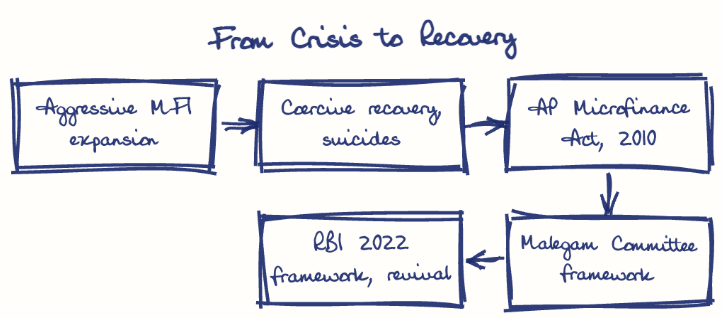
Microfinance in Andhra Pradesh has recovered from the 2010 crisis of reckless lending and coercive recovery, and now rests on responsible lending, digital tools and RBI oversight. The crisis prompted the 2010 state Act and the Malegam Committee, and the RBI's 2022 framework removed interest caps.
Model answer
Ghissu Editorial · Verified 4 Oct 2026 · 240 words
Recovery and Reform
Post-crisis, Andhra Pradesh’s microfinance sector recovered with responsible lending and digital tools such as Aadhaar4 and UPI improving efficiency.
PM MUDRA Yojana Impact
The scheme has significantly expanded credit to micro-entrepreneurs, especially women and marginalized groups, boosting inclusion.
Crisis Causes and Government Response
Aggressive MFI growth caused borrower distress; the 2010 Microfinance Institutions Act imposed strict controls, collapsing lending and prompting RBI’s Malegam Committee reforms.
Economic and Social Fallout
The crisis eroded borrower trust, pushing many to informal lenders and stalling inclusion efforts.
Regulatory Strengthening
RBI’s 2022 framework, applied in Andhra Pradesh, balances borrower protection with lender sustainability, improving sector transparency.
Responsible Lending and Technology
MFIs now emphasize income verification and flexible repayments, adopting digital platforms to enhance credit assessment and risk management.
Financial Literacy and Regional Focus
Targeted literacy campaigns and region-specific microfinance models are needed, especially in drought-prone Rayalaseema and tribal areas.
Digital Expansion and Credit-Plus Services
Strengthening digital infrastructure and offering complementary services like insurance can improve borrower resilience.
This model answer is indicative and the model can make mistakes; please verify key facts independently.
Practise this question
1Get the answer sheet
Sized for this question.
2Write your answer
Timed, by hand.
3Get it marked
Your score and what to fix.
This chapter in the exam
Inclusive Growth: India and AP schemes49 questions
Asked in 8 of 8 sittings since 2008
Most tested: Women empowerment and poverty reduction through AP welfare and credit-linked institutions
- 2025Elaborate on the meaning of Inclusive Growth in the context of the Indian economy. Discuss the key strategies and instruments that can be employed to foster greater inclusion and ensure that the benefits of economic growth reach all sections of society.
- 2025Critically Examine the major poverty alleviation and employment generation programmes in India. How effective have they been in addressing rural and urban poverty?
All 49 questions, sorted by sub-topic, with model answers and practice.
Question from the official APPSC Group-I Mains 2017 paper. Answer written by Ghissu's engine and checked against our editorial standards. Found an error? Tell us and we correct it within 48 hours.