State and discuss the important features of the Handri-Neeva Sujala Sravanthi project and explain its role in meeting the water needs of the Rayalaseema Region.
In short
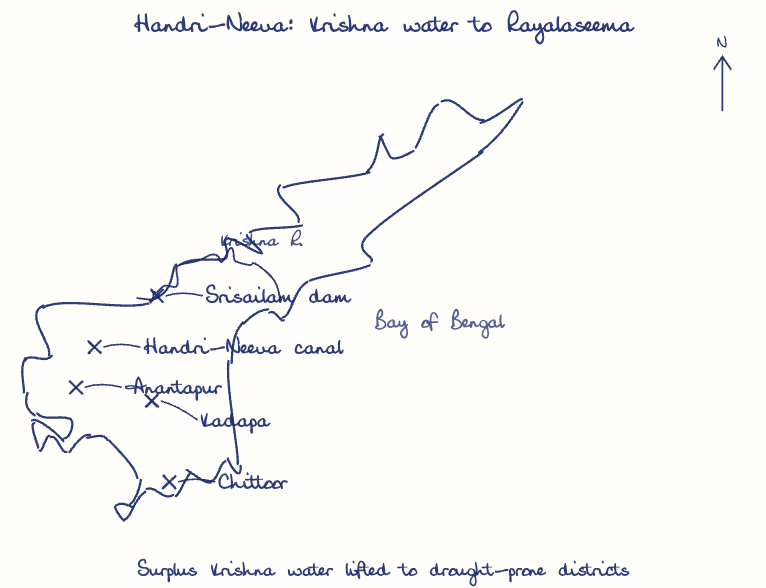
The Handri-Neeva Sujala Sravanthi project is an inter-basin transfer that lifts Krishna water from Srisailam through canals, reservoirs and lift schemes to drought-prone Rayalaseema districts like Anantapur, Kadapa and Chittoor. Its Phase I targets irrigation for about 2.5 lakh acres plus village drinking water, reducing dependence on erratic rainfall.
Model answer
Ghissu Editorial · Verified 4 Oct 2026 · 235 words
Inter-Basin Water Transfer
HNSS channels water from the Srisailam reservoir on the Krishna River to districts like Anantapur, Kadapa, and Chittoor, addressing regional water imbalances.
Multi-Purpose Canal System
The project comprises canals, reservoirs, and lift irrigation schemes facilitating water conveyance for irrigation, drinking, and industrial use.
Augmenting Irrigation Capacity
By increasing irrigated area by about 2.5 lakh acres, HNSS reduces dependence on erratic rainfall and groundwater, stabilizing crop yields in this drought-prone region.
Drinking Water Security
It supplies safe drinking water to rural households, mitigating distress and migration caused by acute scarcity.
Challenges
Delays in land acquisition and rehabilitation of Project Displaced Families1 (PDFs), as seen in the Polavaram Project with only 11% PDFs rehabilitated in 17 years, hamper progress.
Accelerate Rehabilitation and Land Acquisition
Streamlining resettlement and land acquisition is essential for timely project completion.
Integrate with Local Conservation
Combining HNSS with state initiatives like Neeru-Chettu and MGNREGS2 for groundwater recharge will enhance water resilience.
This model answer is indicative and the model can make mistakes; please verify key facts independently.
Practise this question
1Get the answer sheet
Sized for this question.
2Write your answer
Timed, by hand.
3Get it marked
Your score and what to fix.
This chapter in the exam
Agriculture Development in Andhra Pradesh31 questions
Asked in 8 of 8 sittings since 2008
Most tested: Agriculture’s structure, performance, and state policy interventions in Andhra Pradesh.
- 2025Discuss the role of agriculture in the economic development of Andhra Pradesh. How has agriculture contributed to the State Gross Domestic Product (SGDP) in recent years? Identify the key drivers influencing its performance.
- 2025What are the key drivers for the growth of the fisheries sector? What are the schemes undertaken by the fisheries department for the growth of this sector?
All 31 questions, sorted by sub-topic, with model answers and practice.
Question from the official APPSC Group-I Mains 2017 paper. Answer written by Ghissu's engine and checked against our editorial standards. Found an error? Tell us and we correct it within 48 hours.