"The aim of economic reforms in India is to improve the competitiveness and efficiency of domestic industry and pave the way for achieving high rate of economic growth." Discuss.
In short
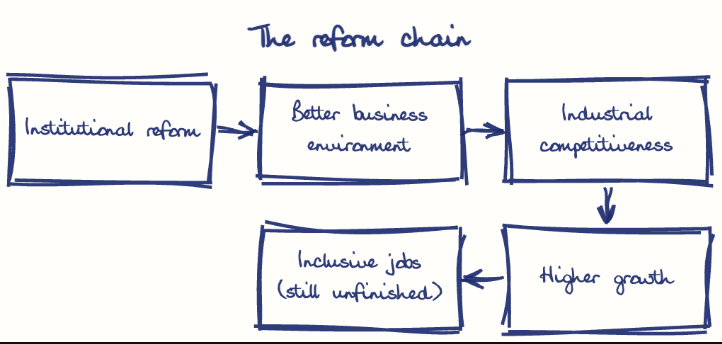
The statement broadly holds: the 1991 reforms dismantled licensing, opened trade and FDI and restructured the public sector, improving industrial competitiveness and lifting growth. India's GDP rose from under $300 billion to around $4 trillion, yet manufacturing's share stays near 15-17% and job creation lags.
Model answer
Ghissu Editorial · Verified 4 Oct 2026 · 260 words
Gradualist Reform Approach
India’s evolutionary reforms enabled political consensus and institutional adaptation, supporting stable industrial growth.
Public Sector and Legal Reforms
Strategic disinvestment and strengthening contract enforcement have improved resource allocation and business environment.
State-Level Capacity
Andhra Pradesh’s proactive fiscal management and ₹94,967 crore own tax revenue projection for 2024-25 highlight the role of state capacity3 in reform success.
MSME Support Schemes
Initiatives like Pradhan Mantri Mudra Yojana4, Credit Guarantee Fund Trust, and MSME Self-Reliant India Fund have expanded credit and technology adoption for MSMEs.
Industrial Growth and Employment
Despite GDP growth, manufacturing’s share remains 15-17%, and job creation lags, with 78.5 lakh non-farm jobs needed annually.
Infrastructure and Credit Access
Infrastructure gaps persist, but schemes like Emergency Credit Line Guarantee Scheme (ECLGS) and state projects in Visakhapatnam port and industrial corridors are addressing bottlenecks.
Legal Overhaul and Digitalisation
Expedite contract enforcement to boost investor confidence.
Inclusive Growth Policies
Align industrial growth with social schemes like PM-KISAN and Prime Minister’s Fasal Bima Yojana (PMFBY) for broad-based benefits.
Infrastructure Development
Leverage public-private partnerships and Andhra Pradesh’s port-led corridors for integrated industrial growth.
This model answer is indicative and the model can make mistakes; please verify key facts independently.
Practise this question
1Get the answer sheet
Sized for this question.
2Write your answer
Timed, by hand.
3Get it marked
Your score and what to fix.
This chapter in the exam
Industrial Development and Policy (India)12 questions
Asked in 5 of 8 sittings since 2008
Most tested: Manufacturing-led industrial policy reform and its policy instruments.
- 2025Discuss the role of the industrial sector in the economic development of India. Discuss the role of the Department of Industrial Policy & Promotion (DIPP).
- 2025Examine the role of the industrial sector in India's economic development. How does industrialisation contribute to income generation, employment, and modernisation of the economy? Support your answer with relevant examples and policy references.
All 12 questions, sorted by sub-topic, with model answers and practice.
Question from the official APPSC Group-I Mains 2017 paper. Answer written by Ghissu's engine and checked against our editorial standards. Found an error? Tell us and we correct it within 48 hours.