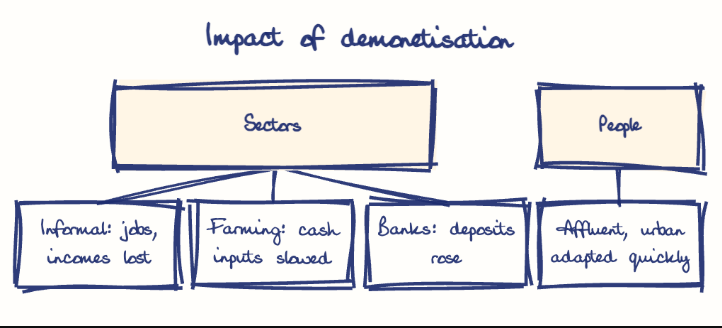
What are the objectives of the demonetization policy announced by the Central Government on 8th November, 2016 ? Discuss its impact on various sectors and various categories of people in the society. Analyse its scope for cashless economy in the near future.
In short
Demonetisation of ₹500 and ₹1000 notes on 8 November 2016 aimed to curb black money, counterfeit currency and terror financing. It hurt informal workers, farmers and the poor briefly but boosted bank deposits and UPI and BHIM payments, making a less-cash economy realistic with digital literacy.
Model answer
Ghissu Editorial · Verified 4 Oct 2026 · 321 words
Eliminate Black Money and Counterfeit Currency
By invalidating high denomination notes, the government2 aimed to force disclosure of unaccounted wealth and disrupt fake currency networks funding terrorism. This also sought to increase tax compliance and formalise the economy.
Social Categories and Inclusion
Urban affluent adapted quickly to digital payments, but poorer and rural populations faced hardships; schemes like PMJDY and digital governance in Andhra Pradesh3 helped bridge the digital divide. The policy also highlighted the digital literacy gap, prompting efforts to promote financial inclusion.
Digital Infrastructure and Behavioural Shift
Post-demonetization, platforms like BHIM, UPI, and Aadhaar-enabled payments grew rapidly; increased bank accounts and tax compliance indicate formalisation; however, digital illiteracy and infrastructure gaps persist. The government’s push for digital payments has led to a significant rise in transaction volumes, signalling a gradual cultural shift.
Way Forward
Enhancing digital literacy and infrastructure, especially in rural areas like Andhra Pradesh, is crucial to sustain momentum towards a cashless economy. Strengthening digital payment security and expanding internet access remain key challenges to address.
This model answer is indicative and the model can make mistakes; please verify key facts independently.
Practise this question
1Get the answer sheet
Sized for this question.
2Write your answer
Timed, by hand.
3Get it marked
Your score and what to fix.
This chapter in the exam
Major Challenges of Indian Economy26 questions
Asked in 8 of 8 sittings since 2008
Most tested: Unemployment and employment structure
- 2025Discuss how infrastructure bottlenecks hinder the growth of the Indian Manufacturing sector. What steps can be taken to address them?
- 2025Analyse the factors contributing to India's Current Account Deficit (CAD) and unfavourable Balance of Payments (BoP) and discuss their implications for the Indian economy.
All 26 questions, sorted by sub-topic, with model answers and practice.
Question from the official APPSC Group-I Mains 2017 paper. Answer written by Ghissu's engine and checked against our editorial standards. Found an error? Tell us and we correct it within 48 hours.