Briefly describe the Sendai Framework for Disaster Risk Reduction and its adoption in the disaster management policy of India.
In short
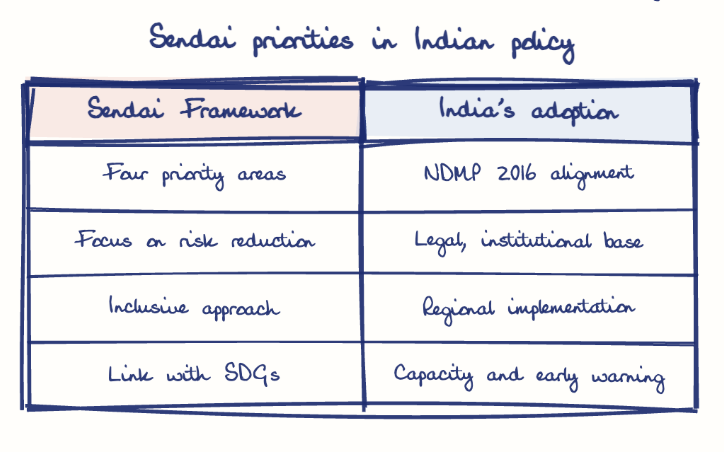
The Sendai Framework (2015-2030) shifts disaster policy from relief to risk reduction through four priorities: understanding risk, strengthening risk governance, investing in resilience and enhancing preparedness. India adopted it through its first National Disaster Management Plan (2016), built explicitly on these priorities, backed by the Disaster Management Act, 2005.
Model answer
Ghissu Editorial · Verified 4 Oct 2026 · 272 words
Four Priority Areas
The framework emphasizes understanding disaster risk, strengthening governance, investing in risk reduction, and enhancing preparedness to build back better.
Inclusive Approach and SDG Integration
It involves all stakeholders, including vulnerable groups, and links disaster risk reduction with sustainable development goals like poverty alleviation and climate action.
National Disaster Management Plan Alignment
India’s 2016 plan explicitly follows Sendai priorities, embedding risk understanding, governance, investment, and preparedness.
Regional and Local Implementation
Tailored strategies, such as using landslide susceptibility zonation for the Eastern Ghats in Andhra Pradesh, reflect Sendai’s context-specific risk focus.
Capacity Building and Early Warning
India expanded seismic observatories (80 in 2014 to 168 by 2025) and strengthened NDRF to 16 battalions, enhancing preparedness.
Community Participation and Climate Resilience
Strengthen vulnerable groups’ roles and invest in climate-resilient infrastructure in Visakhapatnam and Rayalaseema.
Technology and Ecosystem-Based Solutions
Expand early warning systems and promote nature-based risk reduction like wetland restoration in Andhra Pradesh’s river basins.
This model answer is indicative and the model can make mistakes; please verify key facts independently.
Practise this question
1Get the answer sheet
Sized for this question.
2Write your answer
Timed, by hand.
3Get it marked
Your score and what to fix.
This chapter in the exam
Pollution & solid waste; global issues; environmental legislation; disaster management policy; agricultural revolutions43 questions
Asked in 8 of 8 sittings since 2008
Most tested: Solid waste management and pollution-control legislation
- 2025What are the key principles of Integrated Solid Waste Management (ISWM)? Discuss the role of waste hierarchy in ISWM.
- 2025Define global warming, and differentiate it clearly from climate change. Explain the key natural and human-induced causes of global warming and briefly discuss which factors are currently dominant in driving global temperature rise.
All 43 questions, sorted by sub-topic, with model answers and practice.
Question from the official APPSC Group-I Mains 2017 paper. Answer written by Ghissu's engine and checked against our editorial standards. Found an error? Tell us and we correct it within 48 hours.