Critically discuss the various challenges and issues arising out of waste management in Indian towns and cities.
In short
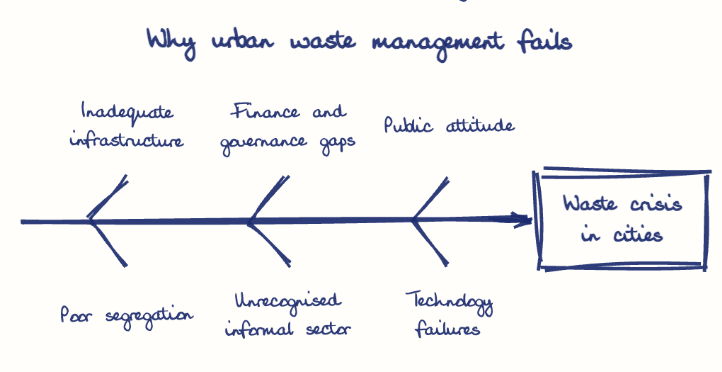
Waste management in Indian cities suffers from poor infrastructure, weak segregation, financially fragile municipalities and a neglected informal sector, causing pollution, health risks and failing waste-to-energy plants. Cities generate about 62 million tons of waste a year, and Andhra Pradesh's dump yards hold 85.89 lakh metric tons of legacy waste.
Model answer
Ghissu Editorial · Verified 4 Oct 2026 · 278 words
Infrastructure and Capacity Gaps
Most ULBs lack sanitary landfills; Andhra Pradesh had only 4 operational sanitary landfill sites out of 123 ULBs in 2022, reflecting critical deficits.
Segregation and Collection Inefficiency
Despite mandates like the Solid Waste Management Rules, 2016 and the Plastic Waste Management Rules, 20164, segregation rates remain low in Andhra Pradesh due to poor enforcement and public awareness.
Financial and Governance Weaknesses
Municipalities’ financial fragility and poor coordination among central, state, and local bodies hinder investment and efficient service delivery.
Environmental and Health Impacts
Improper waste disposal causes soil and water contamination, methane emissions, and public health risks, with legacy waste of 85.89 lakh metric tons in Andhra Pradesh’s dump yards undermining urban sustainability.
Strengthen Infrastructure
Prioritise engineered sanitary landfills and wet waste processing plants, supported by targeted funding, especially in Andhra Pradesh.
Enhance Segregation Compliance
Implement IEC campaigns and integrate waste management education, enforcing SWM Rules strictly.
Formalise Informal Sector
Integrate waste pickers with safety gear and social security to boost recycling and welfare.
Improve Governance and Finance
Establish coordination mechanisms and innovative financing like bankable recycling units for accountability and efficiency.
This model answer is indicative and the model can make mistakes; please verify key facts independently.
Practise this question
1Get the answer sheet
Sized for this question.
2Write your answer
Timed, by hand.
3Get it marked
Your score and what to fix.
This chapter in the exam
Pollution & solid waste; global issues; environmental legislation; disaster management policy; agricultural revolutions43 questions
Asked in 8 of 8 sittings since 2008
Most tested: Solid waste management and pollution-control legislation
- 2025What are the key principles of Integrated Solid Waste Management (ISWM)? Discuss the role of waste hierarchy in ISWM.
- 2025Define global warming, and differentiate it clearly from climate change. Explain the key natural and human-induced causes of global warming and briefly discuss which factors are currently dominant in driving global temperature rise.
All 43 questions, sorted by sub-topic, with model answers and practice.
Question from the official APPSC Group-I Mains 2017 paper. Answer written by Ghissu's engine and checked against our editorial standards. Found an error? Tell us and we correct it within 48 hours.