Describe the most common protozoan diseases, causative agents and preventive measures.
In short
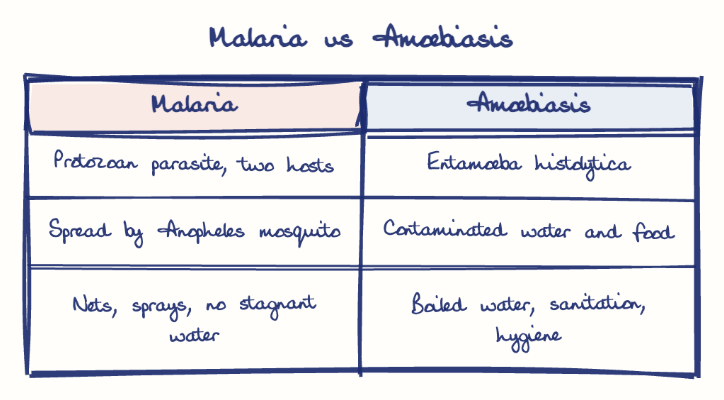
The most common protozoan diseases are malaria (Plasmodium, spread by Anopheles mosquitoes), amoebiasis (Entamoeba histolytica), kala-azar (Leishmania donovani, spread by sandflies) and giardiasis (Giardia lamblia). They are prevented through safe water and sanitation, mosquito nets and source reduction, and early diagnosis under the National Strategic Plan for Malaria Elimination (2023-2027).
Model answer
Ghissu Editorial · Verified 4 Oct 2026 · 257 words
National Malaria Elimination Programme
India’s 2023-2027 strategic plan includes Andhra Pradesh’s Intensified Malaria Elimination Project (IMEP)-31 to reduce malaria through vector control and treatment.
Integrated Disease Surveillance Programme (IDSP)
This central scheme supports outbreak monitoring and timely interventions in Andhra Pradesh.
Vector-Borne Transmission Complexity
Malaria’s life cycle involving humans and mosquitoes complicates control, with rural Andhra Pradesh facing logistical and behavioural hurdles.
Water and Food Contamination
Amoebiasis caused by Entamoeba histolytica spreads through contaminated water and food, aggravated by poor sanitation in Andhra Pradesh.
Personal Hygiene and Sanitation
Public health drives in Andhra Pradesh promote boiled water consumption and waste disposal to prevent amoebiasis.
Vector Control and Protection
Mosquito nets, repellents, and environmental management are actively encouraged through state health programmes.
Health Education and Awareness
Community initiatives educate people on protozoan disease symptoms and prevention to encourage early treatment.
Strengthen Surveillance Systems
Enhance real-time monitoring in Andhra Pradesh for rapid outbreak response.
Expand Access to Diagnostics and Treatment
Improve healthcare infrastructure and drug availability in rural areas.
Promote Community-Led Vector Control
Empower local communities with training and resources.
Integrate Disease Control with Sanitation Schemes
Link protozoan prevention with initiatives like Swachh Andhra.
This model answer is indicative and the model can make mistakes; please verify key facts independently.
Sources
Practise this question
1Get the answer sheet
Sized for this question.
2Write your answer
Timed, by hand.
3Get it marked
Your score and what to fix.
This chapter in the exam
Human diseases; genetic engineering basics; biotechnology in agriculture; vaccines54 questions
Asked in 8 of 8 sittings since 2008
Most tested: Vaccines and immunisation, alongside GM crops/biotech agriculture.
- 2025Discuss the transmission dynamics of respiratory tract infections in densely populated urban settings. Propose effective public health strategies for their prevention.
- 2025Examine how urban infrastructure influences the implementation of preventive measures during microbial disease outbreaks. Suggest technology-driven solutions.
All 54 questions, sorted by sub-topic, with model answers and practice.
Question from the official APPSC Group-I Mains 2017 paper. Answer written by Ghissu's engine and checked against our editorial standards. Found an error? Tell us and we correct it within 48 hours.