Recent observations have shown that the ozone layer over Antarctic shows signs of healing. Critically examine.
In short
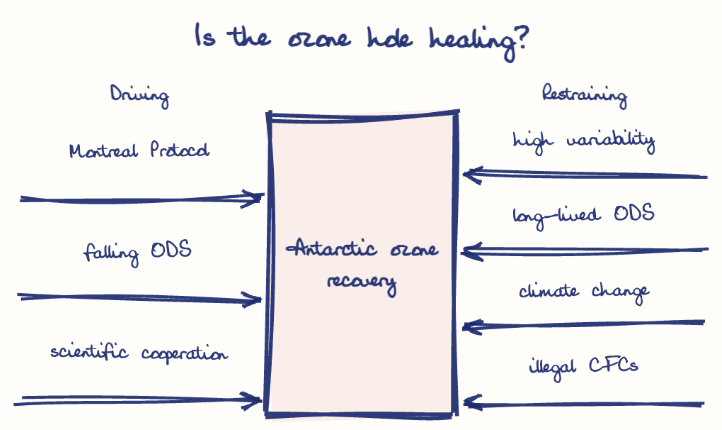
The Antarctic ozone layer is genuinely healing, with smaller, later-forming holes and falling chlorine levels, largely thanks to the Montreal Protocol. Recovery remains slow and fragile because long-lived ODS, illegal CFC emissions, volcanic events and climate-driven stratospheric cooling can set it back, with full recovery expected around the 2060s.
Model answer
Ghissu Editorial · Verified 4 Oct 2026 · 300 words
Observed Recovery Trends
Satellite and ground-based data since the 2000s show gradual ozone increase and shrinking ozone holes, with contributions from India's Maitri and Bharati1 stations enhancing global monitoring.
Montreal Protocol Success
The international treaty, ratified by India in 1992, has effectively reduced ODS like CFCs, correlating with ozone layer recovery.
Stratospheric Temperature and PSCs
Polar stratospheric clouds still form each winter, but with less chlorine and bromine to activate on them, ozone destruction has eased, aiding healing.
Scientific Collaboration
India's hosting of the 46th Antarctic Treaty Consultative Meeting in Kochi in 2024 highlights global South cooperation in polar governance and ozone monitoring.
Long ODS Lifetimes
Persistent banned substances delay full Antarctic recovery, projected only around 2066.
Climate Change Effects
Global warming alters stratospheric temperatures and circulation, sometimes promoting PSC formation and ozone loss.
Illegal ODS Emissions
Unauthorized CFC production threatens recovery, underscoring enforcement challenges.
Regional Vulnerabilities
Coastal Andhra Pradesh faces UV risks from ozone fluctuations, impacting agriculture and health.
Strengthen ODS Enforcement
Enhance monitoring and penalties using international cooperation and India's Antarctic research.
Integrate Climate and Ozone Policies
Align climate action with ozone protection, building on steps like the Kigali Amendment, which phases down HFCs that are potent greenhouse gases.
This model answer is indicative and the model can make mistakes; please verify key facts independently.
Practise this question
1Get the answer sheet
Sized for this question.
2Write your answer
Timed, by hand.
3Get it marked
Your score and what to fix.
This chapter in the exam
Pollution & solid waste; global issues; environmental legislation; disaster management policy; agricultural revolutions43 questions
Asked in 8 of 8 sittings since 2008
Most tested: Solid waste management and pollution-control legislation
- 2025What are the key principles of Integrated Solid Waste Management (ISWM)? Discuss the role of waste hierarchy in ISWM.
- 2025Define global warming, and differentiate it clearly from climate change. Explain the key natural and human-induced causes of global warming and briefly discuss which factors are currently dominant in driving global temperature rise.
All 43 questions, sorted by sub-topic, with model answers and practice.
Question from the official APPSC Group-I Mains 2017 paper. Answer written by Ghissu's engine and checked against our editorial standards. Found an error? Tell us and we correct it within 48 hours.