The Internet of Things (IoT) is expected to be the biggest technological revolution. Examine its likely impact on India.
In short
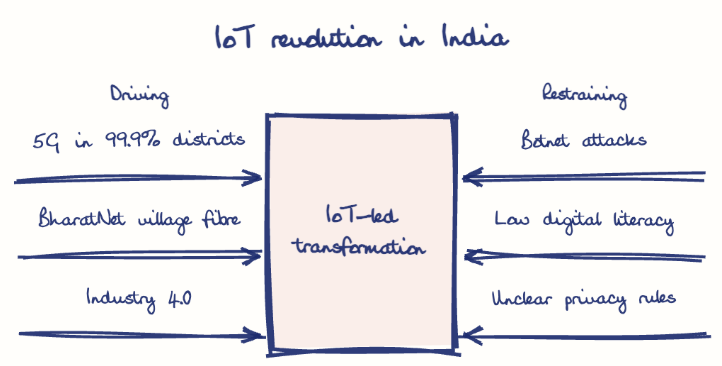
IoT is likely to transform India by raising productivity in manufacturing, logistics and agriculture, improving healthcare and public services and enabling smarter use of water and resources. Its spread is backed by 5G in 99.9% of districts and BharatNet, but cybersecurity, privacy, digital literacy and regulation remain challenges.
Model answer
Ghissu Editorial · Verified 4 Oct 2026 · 287 words
Economic Productivity and Innovation
IoT enables automation and data-driven efficiency in sectors like manufacturing and agriculture; Andhra Pradesh’s aquaculture sector uses IoT sensors to enhance yield, aligning with Make in India2.
Social Inclusion and Service Delivery
IoT supports telemedicine platforms such as eSanjeevani, improving healthcare access in rural Andhra Pradesh, advancing Digital India’s universal service goals.
Enabler of Rural Connectivity
BharatNet’s extension to over 2.15 lakh Gram Panchayats, including in Andhra Pradesh, underpins IoT’s rural reach and inclusive growth.
Strategic Sovereignty and Skill Development
IoT adoption supports Aatmanirbhar Bharat by fostering indigenous innovation through the India AI Mission5 and FutureSkills Prime.
Challenges in Scalability and Regulation
Uneven digital literacy and infrastructure gaps, especially in Rayalaseema, require policy focus on data privacy and standards.
Strengthen Cybersecurity
Develop IoT security standards to protect infrastructure and data.
Promote Digital Literacy
Localized programs in Andhra Pradesh’s rural districts to ensure equitable IoT use.
Support Indigenous R&D
Encourage innovation in Visakhapatnam and Sriharikota to enhance technological sovereignty.
Align with Sustainability
Use IoT for water and agriculture management in Rayalaseema.
This model answer is indicative and the model can make mistakes; please verify key facts independently.
Practise this question
1Get the answer sheet
Sized for this question.
2Write your answer
Timed, by hand.
3Get it marked
Your score and what to fix.
This chapter in the exam
Information and Communication Technology (ICT)24 questions
Asked in 8 of 8 sittings since 2008
Most tested: E-governance and digital public service delivery
- 2025Discuss the evolution of e-governance in India, highlighting key initiatives. Analyze how these initiatives have transformed public service delivery and enhanced citizen engagement.
- 2025Define cybercrime. Discuss the major types of cybercrimes prevalent in India today.
All 24 questions, sorted by sub-topic, with model answers and practice.
Question from the official APPSC Group-I Mains 2017 paper. Answer written by Ghissu's engine and checked against our editorial standards. Found an error? Tell us and we correct it within 48 hours.