What are monoclonal antibodies ? How are they useful in detecting parasitic diseases ?
In short
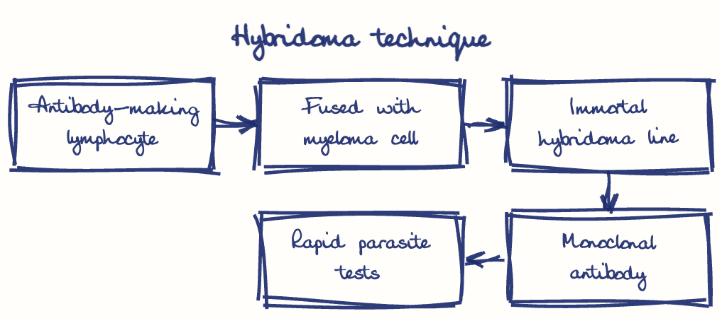
Monoclonal antibodies are identical antibodies against a single antigen, produced by the hybridoma technique that Kohler and Milstein developed in 1975. Their specificity lets them identify parasites such as Plasmodium, Leishmania and Wuchereria, power rapid point-of-care tests for malaria and pair with PCR when parasite load is low.
Model answer
Ghissu Editorial · Verified 4 Oct 2026 · 258 words
Hybridoma Technology Foundation
Developed by Kohler and Milstein in 1975, hybridoma technology enables continuous production of uniform mAbs by fusing antibody-producing lymphocytes with myeloma cells. This breakthrough underpins India’s immunodiagnostic research and applications.
Policy and Institutional Support
Government initiatives like MedTech Mitra21 and the Pradhan Mantri - Ayushman Bharat Health Infrastructure Mission have accelerated the development and deployment of mAb-based diagnostic kits. These are integrated into national programs such as the National Leprosy Eradication Programme3 and the Intensified Malaria Elimination Project, enhancing disease detection capacity in Andhra Pradesh.
Surveillance Integration and Enhanced Sensitivity
mAb diagnostics support the Test, Treat, Track strategy4, enabling timely public health responses and aiding malaria elimination efforts. Combining mAbs with molecular methods like PCR further improves sensitivity, allowing early detection even at low parasite loads.
Public-Private Partnerships
Encouraging collaboration between government research bodies and private biotech firms in Andhra Pradesh can accelerate commercialization and distribution of affordable mAb diagnostic kits, expanding access and impact.
This model answer is indicative and the model can make mistakes; please verify key facts independently.
Practise this question
1Get the answer sheet
Sized for this question.
2Write your answer
Timed, by hand.
3Get it marked
Your score and what to fix.
This chapter in the exam
Biotechnology & Nanotechnology: scope, ethics, genetic engineering, biodiversity, fermentation, immuno-diagnosis50 questions
Asked in 8 of 8 sittings since 2008
Most tested: Biodiversity and biotechnology governance/ethics, especially conservation, GMOs, and applied public-health biotech.
- 2025Trace the evolution of India's National Biotechnology Development Strategy (NBDS) and discuss its key objectives. Critically evaluate its impact on the growth of the biotechnology sector in India.
- 2025Analyze the potential of plant-derived biopharmaceuticals in promoting sustainable healthcare. Explain how the application of green pharmacy principles can help minimize environmental harm at each stage of the pharmaceutical lifecycle.
All 50 questions, sorted by sub-topic, with model answers and practice.
Question from the official APPSC Group-I Mains 2017 paper. Answer written by Ghissu's engine and checked against our editorial standards. Found an error? Tell us and we correct it within 48 hours.