What are the advantages and disadvantages of solar power over other renewable energy resources ? Why is the cost of solar energy decreasing ? What is its effect on climate change efforts ?
In short
Solar power is abundant, scalable and cheap to run, but needs much land, works only in daylight and depends on imported modules. Its cost is falling due to efficiency gains, mass manufacturing, PLI support and cheap Chinese supply, which helped India cross 50 percent non-fossil capacity in 2025.
Model answer
Ghissu Editorial · Verified 4 Oct 2026 · 343 words
Abundant and Predictable Resource
Solar energy benefits from ~300 sunny days annually, providing a reliable source compared to variable wind or biomass; PM Surya Ghar Yojana exemplifies rooftop solar’s decentralization.
Low Operational Costs
Solar systems have fewer moving parts and lower maintenance than wind or hydropower, enhancing reliability and reducing expenses.
Land and Storage Challenges
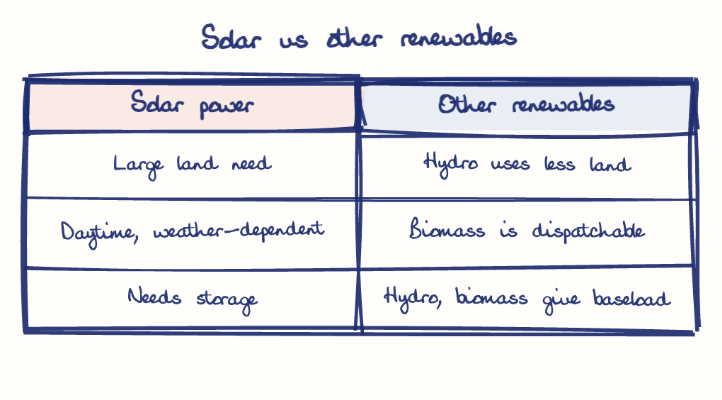
Solar farms require large land areas, competing with agriculture in fertile regions like the Godavari and Krishna deltas, and need costly storage due to intermittency, unlike biomass or hydropower which provide baseload power.
Import Dependence and Environmental Concerns
India imports about half its solar modules, mainly from China, creating supply risks; manufacturing involves hazardous materials, raising environmental issues.
Technological and Policy Support
Photovoltaic efficiency improvements, domestic manufacturing capacity (91 GW/year), and schemes like PM-KUSUM and the National Solar Mission have driven down costs.
Innovative Financing
Programs like PM Surya Ghar enable affordable distributed solar through net metering and subsidies, especially benefiting rural areas.
Emission4 Reduction
Solar power displaces fossil fuels, aiding India’s National Action Plan on Climate Change (NAPCC) and Perform Achieve and Trade (PAT) scheme targets.
This model answer is indicative and the model can make mistakes; please verify key facts independently.
Practise this question
1Get the answer sheet
Sized for this question.
2Write your answer
Timed, by hand.
3Get it marked
Your score and what to fix.
This chapter in the exam
Energy: needs, resources, policy; Nuclear programme and policy24 questions
Asked in 8 of 8 sittings since 2008
Most tested: Renewable energy transition in India, especially solar/clean energy and barriers to large-scale adoption.
- 2025Differentiate between conventional and non-conventional energy resources. Explain their relevance in India's energy sector.
- 2023What is the current scenario of renewable power generation in India ? Discuss the factors responsible for the growing focus and shift towards Renewable energy.
All 24 questions, sorted by sub-topic, with model answers and practice.
Question from the official APPSC Group-I Mains 2017 paper. Answer written by Ghissu's engine and checked against our editorial standards. Found an error? Tell us and we correct it within 48 hours.