What are the benefits of "Smart Grid" ? Examine the challenges and strategies for "Smart Grid" operations in India.
In short
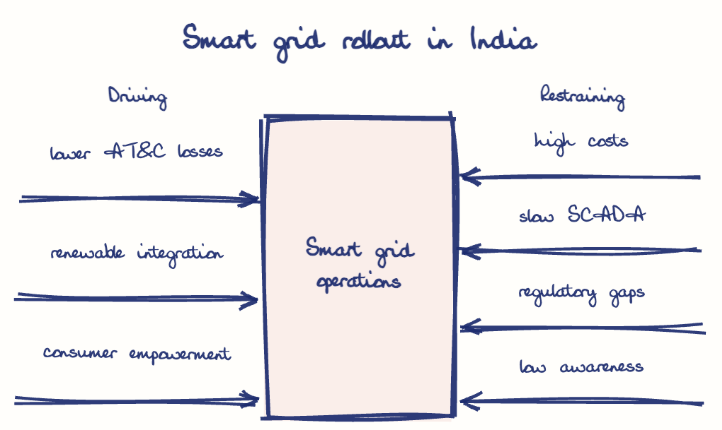
Smart grids cut AT&C losses, integrate solar and wind, improve outage management and let consumers manage demand through smart meters. India faces high costs for stressed discoms, slow SCADA systems, regulatory gaps and privacy concerns, which phased NSGM pilots, EESL's BOOT model for smart meters and SERC reforms can address.
Model answer
Ghissu Editorial · Verified 4 Oct 2026 · 309 words
Loss Reduction and Efficiency
Smart grids reduce Aggregate Technical & Commercial (AT&C) losses by up to 17%, improving utility revenues and curbing theft, demonstrated in Andhra Pradesh and Uttar Pradesh pilot projects. Real-time monitoring enables better fault detection and power flow control.
Renewable Energy Integration
They enable stable integration of solar and wind, crucial for Andhra Pradesh’s contribution as India's non-fossil share has reached about half of installed capacity. Smart grids manage variability and maintain grid stability, supporting the state’s renewable expansion goals.
High Costs and Infrastructure Gaps
Deployment costs and outdated metering systems strain discoms in Andhra Pradesh, complicating upgrades. Existing SCADA systems have slow update rates (~5 seconds), insufficient for advanced functions, especially in rural areas.
Pilot Projects and Financial Models
Expanding NSGM pilots and leveraging Smart Meter National Programme with EESL’s BOOT model reduce costs and build confidence in Andhra Pradesh. Public-private partnerships can mobilize investments and expertise.
Capacity Building and Regulatory Reforms3
Training utility staff and strengthening SERC roles in tariff design and data governance foster smart grid adoption. Consumer education campaigns can improve acceptance and participation.
This model answer is indicative and the model can make mistakes; please verify key facts independently.
Practise this question
1Get the answer sheet
Sized for this question.
2Write your answer
Timed, by hand.
3Get it marked
Your score and what to fix.
This chapter in the exam
Energy: needs, resources, policy; Nuclear programme and policy24 questions
Asked in 8 of 8 sittings since 2008
Most tested: Renewable energy transition in India, especially solar/clean energy and barriers to large-scale adoption.
- 2025Differentiate between conventional and non-conventional energy resources. Explain their relevance in India's energy sector.
- 2023What is the current scenario of renewable power generation in India ? Discuss the factors responsible for the growing focus and shift towards Renewable energy.
All 24 questions, sorted by sub-topic, with model answers and practice.
Question from the official APPSC Group-I Mains 2017 paper. Answer written by Ghissu's engine and checked against our editorial standards. Found an error? Tell us and we correct it within 48 hours.