What effects does PM2.5 fine particulate matter have on the health of individuals in urban regions of India and across the world ? Discuss.
In short
PM2.5 particles penetrate deep into the lungs and bloodstream, causing asthma, bronchitis, heart attacks, strokes and lung cancer, and hit children, the elderly and the sick hardest. Indian cities face higher exposure and weaker care than most, and air pollution caused 1.7 million premature Indian deaths in 2019.
Model answer
Ghissu Editorial · Verified 4 Oct 2026 · 271 words
Respiratory and Cardiovascular Diseases
PM2.5 particles penetrate deep into lungs and bloodstream, causing asthma, chronic bronchitis, hypertension, and heart attacks; Delhi’s Centre for Chest Surgery reports rising lung cancer among young non-smokers linked to PM2.5.
Increased Mortality and Morbidity
The Lancet (2019) estimated 1.7 million premature deaths in India from air pollution, with PM2.5 a major contributor, imposing heavy economic costs.
Vulnerable Populations at Greater Risk
Children, elderly, and urban poor face higher exposure and limited healthcare access; Andhra Pradesh1’s 2024 CAG audit reveals health infrastructure gaps, including medical vacancies.
Emerging Ultra-Fine Particle Concerns
PM1 and smaller particles carry toxic metals causing gene damage and cancer, but monitoring remains inadequate globally and in India.
Higher Pollution Levels in Indian Cities
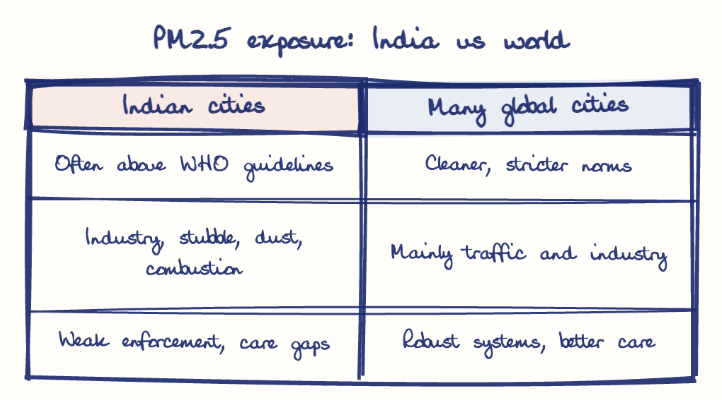
Delhi, Mumbai, and Visakhapatnam regularly exceed WHO PM2.5 limits, unlike many global cities with stricter emission norms2.
Policy and Infrastructure Gaps
India struggles with enforcement and urban waste management; Andhra Pradesh’s 2022 audit highlights solid waste management gaps contributing to pollution.
Health System Preparedness Differences
Developed countries have better healthcare infrastructure, while Andhra Pradesh faces shortages limiting pollution-related disease management.
Strengthen Monitoring and Standards
Enforce stricter PM2.5 and ultra-fine particle norms, especially in Andhra Pradesh.
Improve Urban Waste Management
Address 2022 CAG audit findings to reduce particulate emissions from waste and construction.
This model answer is indicative and the model can make mistakes; please verify key facts independently.
Practise this question
1Get the answer sheet
Sized for this question.
2Write your answer
Timed, by hand.
3Get it marked
Your score and what to fix.
This chapter in the exam
Pollution & solid waste; global issues; environmental legislation; disaster management policy; agricultural revolutions43 questions
Asked in 8 of 8 sittings since 2008
Most tested: Solid waste management and pollution-control legislation
- 2025What are the key principles of Integrated Solid Waste Management (ISWM)? Discuss the role of waste hierarchy in ISWM.
- 2025Define global warming, and differentiate it clearly from climate change. Explain the key natural and human-induced causes of global warming and briefly discuss which factors are currently dominant in driving global temperature rise.
All 43 questions, sorted by sub-topic, with model answers and practice.
Question from the official APPSC Group-I Mains 2017 paper. Answer written by Ghissu's engine and checked against our editorial standards. Found an error? Tell us and we correct it within 48 hours.