Write a brief account of Bentham and Hooker's classification and discuss its demerits.
In short
Bentham and Hooker's natural classification, published in Genera Plantarum (1862 to 1883), divides seed plants into Dicotyledons, Gymnospermae and Monocotyledons, covering 202 orders. Its demerits include not being phylogenetic, placing gymnosperms between dicots and monocots, the artificial Monochlamydeae and ignoring anatomy and chemistry.
Model answer
Ghissu Editorial · Verified 4 Oct 2026 · 324 words
Basis and scope
Plants are grouped on many characters taken together, mainly floral ones; it covers seed plants only, with about 202 natural orders (families), 7,569 genera and 97,205 species.
Classes
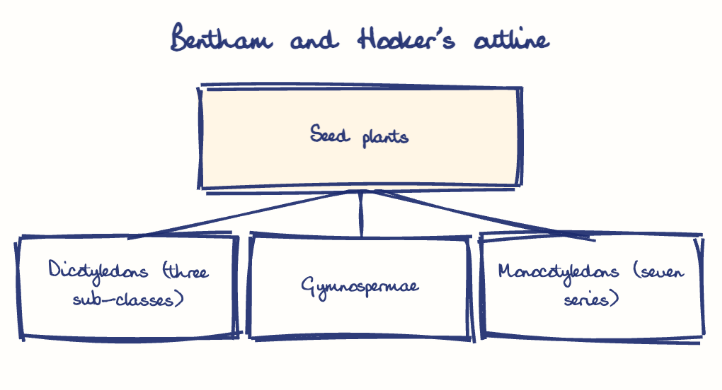
Seed plants are divided into Dicotyledons, Gymnospermae and Monocotyledons.
Dicotyledons
Three sub-classes: Polypetalae (Thalamiflorae, Disciflorae, Calyciflorae), Gamopetalae (Inferae, Heteromerae, Bicarpellatae) and Monochlamydeae (eight series).
Gymnosperms and monocots
Gymnospermae has three orders (Gnetaceae, Coniferae, Cycadaceae); Monocotyledons has seven series from Microspermae (orchids) to Glumaceae (grasses).
Practical
Based on actual specimens, it is accurate and easy for identification.
Natural
Related families are largely kept together, and Ranales is rightly placed first among dicots.
Not phylogenetic
It does not show evolutionary relationships, though published after Darwin.
Gymnosperms misplaced
They are placed between dicots and monocots, although they are a separate, more primitive group.
Artificial Monochlamydeae
Unrelated families are grouped only for lacking petals, separating related families such as Euphorbiaceae from their relatives.
Misplaced orchids
The advanced Orchidaceae is placed at the start of monocots, before the more primitive Liliaceae.
Narrow evidence
It ignores anatomy, embryology, cytology and chemistry, and excludes cryptogams.
This model answer is indicative and the model can make mistakes; please verify key facts independently.
Practise this question
1Get the answer sheet
Sized for this question.
2Write your answer
Timed, by hand.
3Get it marked
Your score and what to fix.
This chapter in the exam
Biotechnology & Nanotechnology: scope, ethics, genetic engineering, biodiversity, fermentation, immuno-diagnosis50 questions
Asked in 8 of 8 sittings since 2008
Most tested: Biodiversity and biotechnology governance/ethics, especially conservation, GMOs, and applied public-health biotech.
- 2025Trace the evolution of India's National Biotechnology Development Strategy (NBDS) and discuss its key objectives. Critically evaluate its impact on the growth of the biotechnology sector in India.
- 2025Analyze the potential of plant-derived biopharmaceuticals in promoting sustainable healthcare. Explain how the application of green pharmacy principles can help minimize environmental harm at each stage of the pharmaceutical lifecycle.
All 50 questions, sorted by sub-topic, with model answers and practice.
Question from the official APPSC Group-I Mains 2017 paper. Answer written by Ghissu's engine and checked against our editorial standards. Found an error? Tell us and we correct it within 48 hours.