Briefly describe the flora and fauna of National Parks in Andhra Pradesh.
In short
Andhra Pradesh's national parks are dominated by dry deciduous forests with teak and endemics like red sanders and Cycas beddomei, and shelter tigers, panthers, blackbuck, sambar and estuarine fishing cats and otters. Key parks include Sri Venkateswara in the Seshachalam hills and Papikonda along the Godavari gorge.
Model answer
Ghissu Editorial · Verified 4 Oct 2026 · 265 words
Forest Department Oversight
The Andhra Pradesh Forest Department enforces the Wildlife Protection Act, 1972, managing forests and wildlife with strict legal frameworks prohibiting human exploitation and grazing, ensuring ecosystems remain undisturbed.
Key National Parks and Schemes
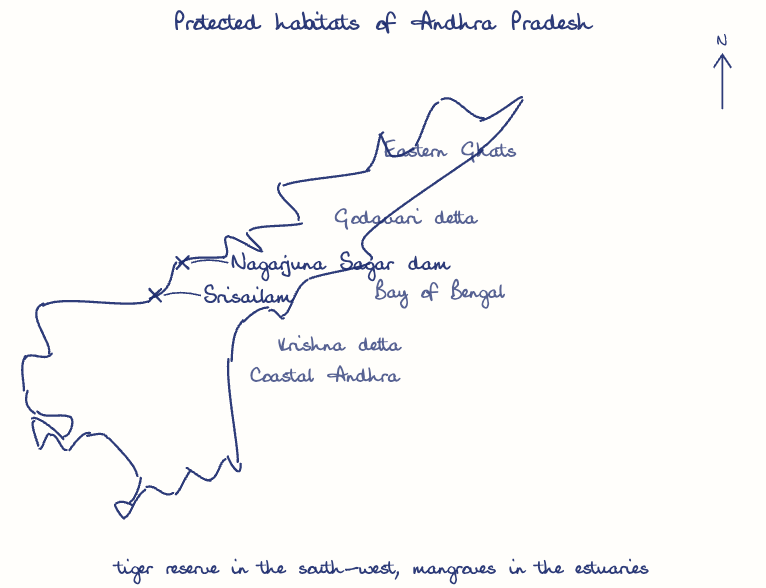
Nagarjunasagar-Srisailam Tiger Reserve, one of India’s largest tiger reserves, and participation in Project Tiger4 and Project Elephant bolster conservation efforts, protecting flagship species and their habitats.
Mangrove Ecosystems and Eco-friendly Practices
Mangroves in Godavari and Krishna estuaries protect coastal biodiversity and act as natural buffers; the forest department adopts eco-friendly nurseries and Miyawaki-style dense mini forests enhancing native species regeneration.
Aquatic and Keystone Species
Mangroves shelter fishing cats and otters; freshwater bodies sustain turtles; Project Tiger and other schemes have stabilized and gradually increased key species populations despite challenges like habitat fragmentation.
Habitat Connectivity and Community Participation
Enhance ecological corridors between parks to facilitate wildlife movement and genetic exchange; involve local communities through awareness programs, eco-tourism, and sustainable forest use.
Scientific Research and Climate Resilience
Invest in biodiversity assessments, GIS-based threat mapping, and implement climate-adaptive conservation plans to safeguard vulnerable flora and fauna against changing weather patterns.
This model answer is indicative and the model can make mistakes; please verify key facts independently.
Practise this question
1Get the answer sheet
Sized for this question.
2Write your answer
Timed, by hand.
3Get it marked
Your score and what to fix.
This chapter in the exam
Fauna and Floral Geography5 questions
Asked in 3 of 8 sittings since 2008
Most tested: Andhra Pradesh-specific wildlife and biodiversity conservation
- 2025Discuss the key aspects of wildlife conservation and biodiversity in Andhra Pradesh.
- 2023Discuss the various forest conservation programmes in India.
All 5 questions, sorted by sub-topic, with model answers and practice.
Question from the official APPSC Group-I Mains 2020 paper. Answer written by Ghissu's engine and checked against our editorial standards. Found an error? Tell us and we correct it within 48 hours.