Discuss the key aspects of wildlife conservation and biodiversity in Andhra Pradesh.
In short
Wildlife conservation in Andhra Pradesh rests on a protected area network, habitat development, human-wildlife conflict management and forest laws, protecting rich biodiversity from Eastern Ghats forests to coastal mangroves, including endemics like red sanders. Flagship sites include the Nagarjunasagar-Srisailam Tiger Reserve, the Coringa mangroves and the Pulicat and Kolleru wetlands.
Model answer
Ghissu Editorial · Verified 4 Oct 2026 · 262 words
Protected Areas Network
The state’s network of national parks, wildlife sanctuaries, and conservation reserves safeguards critical habitats for species like tigers, panthers, and sea turtles, supported by the Wildlife Protection5 Act, 1972 and National Wildlife Action Plan (2017-2031).
Integrated Wildlife Habitat Development
The Centrally Sponsored Scheme enhances habitat restoration, anti-poaching, and community participation to secure wildlife habitats. Additionally, compensation schemes and awareness programs help manage human-wildlife conflicts in forest-adjacent districts like Visakhapatnam.
Floral and Faunal Richness
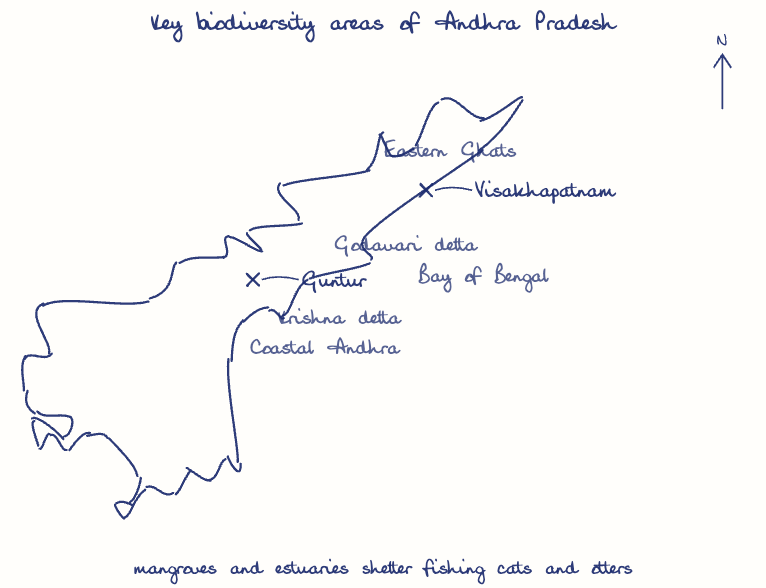
Endemic plants such as Cycas beddomei, Pterocarpus santalinus, and flagship fauna including tigers, blackbucks, and fishing cats underscore Andhra Pradesh’s biodiversity importance.
Ecosystem Variety and Economic Role
Diverse ecosystems from tropical dry deciduous forests to mangrove wetlands support fisheries, ecotourism, and agriculture, contributing significantly to rural livelihoods and the state’s socio-economic development.
Community Involvement and Climate Adaptation
Local participation, recognising traditional ecological knowledge, and climate resilience measures align with the National Wildlife Action Plan to sustain ecosystems and wildlife habitats amid shifting climatic patterns.
Promote Community-Based Conservation
Expand participatory approaches involving local communities in decision-making and benefit-sharing to reduce human-wildlife conflicts and promote sustainable resource use.
This model answer is indicative and the model can make mistakes; please verify key facts independently.
Practise this question
1Get the answer sheet
Sized for this question.
2Write your answer
Timed, by hand.
3Get it marked
Your score and what to fix.
This chapter in the exam
Fauna and Floral Geography5 questions
Asked in 3 of 8 sittings since 2008
Most tested: Andhra Pradesh-specific wildlife and biodiversity conservation
- 2023Discuss the various forest conservation programmes in India.
- 2023Discuss various in situ conservation strategies of biodiversity in Andhra Pradesh.
All 5 questions, sorted by sub-topic, with model answers and practice.
Question from the official APPSC Group-I Mains 2025 paper. Answer written by Ghissu's engine and checked against our editorial standards. Found an error? Tell us and we correct it within 48 hours.