Critically analyse the components and impacts of the Green Revolution in India.
In short
The Green Revolution combined high-yielding seeds, irrigation, chemical fertilisers, credit and mechanisation to make India self-sufficient in foodgrains by the 1970s, but widened inequality and degraded soil and groundwater. In Andhra Pradesh, Nagarjuna Sagar and the Godavari and Krishna delta canals made the coastal belt an early beneficiary.
Model answer
Ghissu Editorial · Verified 4 Oct 2026 · 272 words
High-Yielding Variety Seeds and Irrigation
Genetically improved seeds for wheat and rice, supported by irrigation infrastructure such as Nagarjuna Sagar and the Godavari and Krishna delta canals in Andhra Pradesh, were central to yield increases.
Chemical Fertilizers and Credit Schemes
Intensive use of fertilizers and pesticides boosted productivity but caused ecological damage; schemes like Rashtriya Krishi Vikas Yojana4 (RKVY) and Pradhan Mantri Fasal Bima Yojana (PMFBY) supported farmers with credit and insurance.
Food Security and Economic Growth
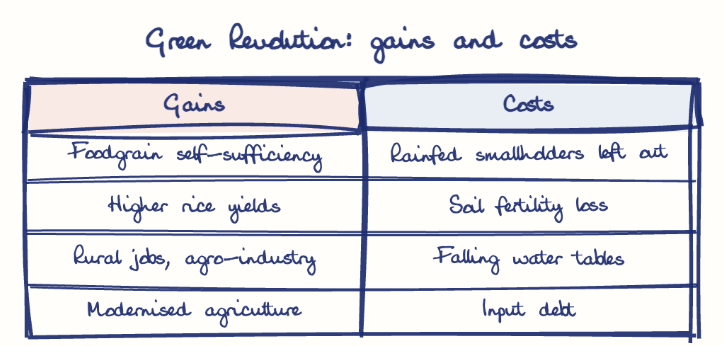
India achieved self-sufficiency by the 1970s, with increased rice yields in Andhra Pradesh and rural employment growth in agro-industries.
Social Inequality and Environmental Costs
Benefits were uneven, favoring irrigated regions and larger farmers, while smallholders faced exclusion; ecological issues included soil fertility decline and groundwater depletion.
Sustainability Challenges
The revolution’s regional focus and commercialization led to agrarian inequalities and environmental degradation, highlighting the need for sustainable practices like those promoted under the National Mission for Sustainable Agriculture (NMSA) and Soil Health Card Scheme.
Future Directions
Expanding irrigation, promoting organic farming, and strengthening schemes like Rashtriya Krishi Vikas Yojana (RKVY) can address disparities and ecological concerns.
This model answer is indicative and the model can make mistakes; please verify key facts independently.
Practise this question
1Get the answer sheet
Sized for this question.
2Write your answer
Timed, by hand.
3Get it marked
Your score and what to fix.
This chapter in the exam
Economic Geography6 questions
Asked in 3 of 8 sittings since 2008
Most tested: Andhra Pradesh’s economic infrastructure and sectoral development, especially ports, agriculture, and manufacturing.
- 2025Discuss the background of agriculture in Andhra Pradesh and critically examine how key agricultural inputs such as rainfall, temperature, irrigation and power are likely to be affected by climate change.
- 2025Highlight the industrial importance and major manufacturing sectors of Andhra Pradesh.
All 6 questions, sorted by sub-topic, with model answers and practice.
Question from the official APPSC Group-I Mains 2020 paper. Answer written by Ghissu's engine and checked against our editorial standards. Found an error? Tell us and we correct it within 48 hours.