Critically explain the causes of the emergence of Buddhism in ancient India.
In short
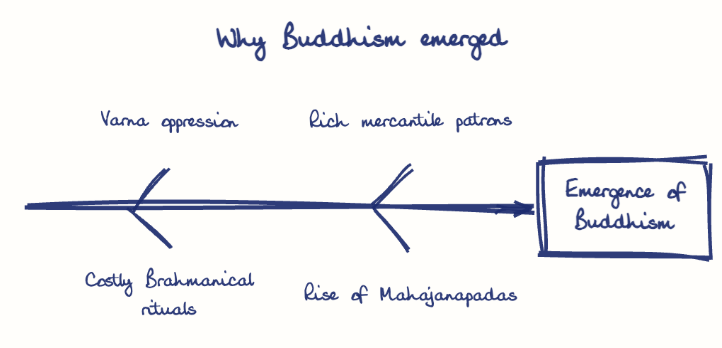
Buddhism emerged in the sixth century BCE from caste oppression, dissatisfaction with costly Brahmanical rituals, urban prosperity that created mercantile patrons, and the needs of the new iron-plough agrarian economy. Its ethic of non-violence protected cattle that sacrifices consumed, while Ashoka's patronage later institutionalised the faith.
Model answer
Ghissu Editorial · Verified 4 Oct 2026 · 268 words
Caste Oppression and Egalitarianism
Buddhism rejected caste hierarchy, attracting marginalized groups and the gana-sanghas (republics) such as the Sakyas and Licchavis.
Religious Dissatisfaction and Core Philosophy
The Four Noble Truths1 and Noble Eightfold Path offered a moral, rational alternative to Brahmanical rituals.
Economic Prosperity and Patronage
Urbanization and trade empowered merchants who funded Buddhist monasteries, turning them into centers of learning and welfare.
Political Decentralization and Urban Growth
The Mahajanapadas’ rise fostered religious experimentation, enabling Buddhism’s reformist appeal.
Ashoka’s Support and Missionary Activity
Ashoka’s edicts and councils institutionalized Buddhism, expanding its influence.
Cultural Adaptability
Buddhism assimilated local cults like the Naga fertility cult and welcomed all castes and women, evident in Amaravati Stupa art.
Philosophical Depth
Nagarjuna’s Madhyamaka doctrine reinforced Buddhism’s intellectual appeal amid competing ideologies.
Promote Buddhist Scholarship
Expand academic programs and scholarships, following Indian initiatives for Vietnamese scholars.
Preserve Heritage Sites
Invest in conserving Buddhist monuments in Andhra Pradesh to sustain cultural memory.
Leverage Soft Power
Integrate Buddhist ethics into diplomacy, as in the Asian Buddhist Summit2 2024.
Inclusive Social Policies
Strengthen social justice inspired by Buddhist equality and compassion.
This model answer is indicative and the model can make mistakes; please verify key facts independently.
Practise this question
1Get the answer sheet
Sized for this question.
2Write your answer
Timed, by hand.
3Get it marked
Your score and what to fix.
This chapter in the exam
Ancient India - Pre-history, IVC, Vedic, Mauryas, Kushans, Satavahanas, Sangam, Guptas16 questions
Asked in 8 of 8 sittings since 2008
Most tested: Harappan civilisation—urban planning, origin/decline, and continuity.
- 2025Discuss the origin and expansion of the Indus Valley Civilization.
- 2025Briefly analyze the teachings of Buddha and Mahavira.
All 16 questions, sorted by sub-topic, with model answers and practice.
Question from the official APPSC Group-I Mains 2020 paper. Answer written by Ghissu's engine and checked against our editorial standards. Found an error? Tell us and we correct it within 48 hours.