Critically explain the circumstances which led to the formation of Justice Party.
In short
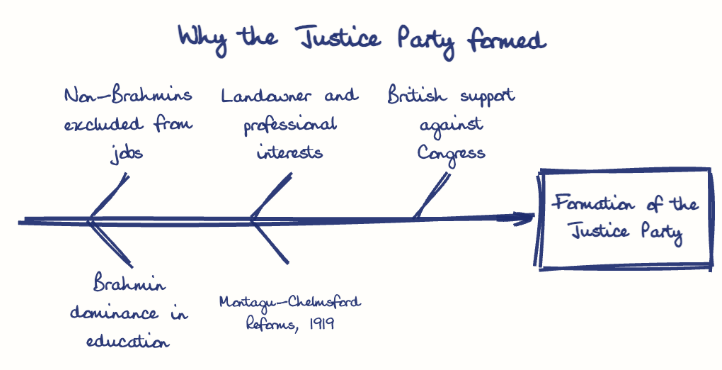
The Justice Party arose from non-Brahmin elites' exclusion from jobs, education and legislatures in the Madras Presidency, starting as the South Indian Liberal Federation founded in 1916 by T M Nair and Theagaraya Chetty. Colonial patronage and the Congress boycott of 1920 let it win 63 of 98 seats.
Model answer
Ghissu Editorial · Verified 4 Oct 2026 · 283 words
Political Marginalization and Opportunity
The Montagu-Chelmsford Reforms (1919) introduced dyarchy; Congress’s 1920 election boycott created a vacuum the Justice Party filled by winning 63 of 98 seats. This electoral success marked the first time non-Brahmins gained significant legislative power in Madras.
Regional and Communal Divides
Tamil-Telugu tensions and reluctance to support a separate Andhra province weakened party cohesion. The Andhra leaders’ poor grassroots support reflected these intra-regional divides, complicating the party’s pan-Madras appeal.
Montagu-Chelmsford Reforms and Patronage
British reforms created political space; colonial support helped the Justice Party counter Congress’s nationalist threat but fostered dependence on British goodwill. The party’s collaboration with the colonial government ensured administrative backing but limited its nationalist credentials.
Regional Rivalries
The party’s dominance faced challenges from the Swaraj Party and Congress’s rise, which gradually eroded its political base by appealing to broader nationalist and social reform agendas.
This model answer is indicative and the model can make mistakes; please verify key facts independently.
Practise this question
1Get the answer sheet
Sized for this question.
2Write your answer
Timed, by hand.
3Get it marked
Your score and what to fix.
This chapter in the exam
Andhra - Nationalist Movement and Formation of the State22 questions
Asked in 8 of 8 sittings since 2008
Most tested: Formation of Andhra Pradesh and the Andhra-Telangana statehood process
- 2025What were the provisions of the Gentlemen's Agreement of 1956? How far could they satisfy apprehensions of the Telangana region?
- 2025Outline the role of the students in raising major issues in the 1969 Telangana agitation.
All 22 questions, sorted by sub-topic, with model answers and practice.
Question from the official APPSC Group-I Mains 2020 paper. Answer written by Ghissu's engine and checked against our editorial standards. Found an error? Tell us and we correct it within 48 hours.