Critically explain the salient features of urban planning of Harappan Civilization.
In short
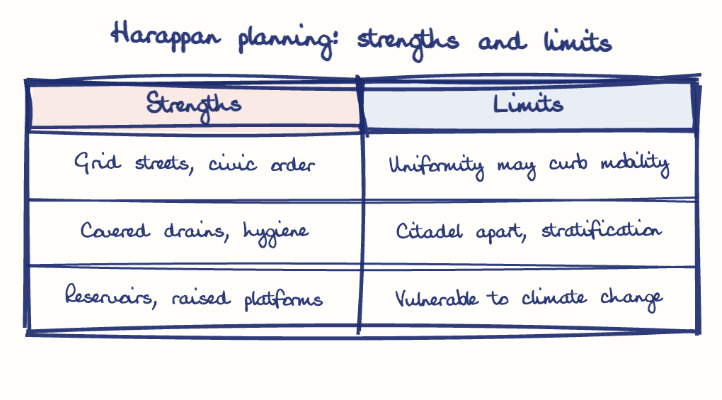
Harappan urban planning featured grid-pattern streets, citadel and lower-town divisions, covered drainage, standardised kiln-fired bricks and advanced water management, reflecting strong civic order, though its segregation hints at social hierarchy and its resilience failed against climate change. Dholavira's large reservoirs show sophisticated rainwater harvesting.
Model answer
Ghissu Editorial · Verified 4 Oct 2026 · 264 words
Grid Pattern Layout
Cities like Mohenjo-Daro and Harappa used a grid system aligned to cardinal points, facilitating movement and urban order.
Citadel and Lower Town
The raised citadel housed civic structures like the Great Bath, while the lower town contained residential areas, reflecting social hierarchy.
Advanced Drainage and Sanitation
Covered drains alongside streets connected to house drains ensured effective waste management, a hallmark of Harappan urbanism.
Standardized Building Materials and Water Management
Uniform kiln-fired bricks and large reservoirs in Dholavira indicate quality control and advanced rainwater harvesting.
Civic Order and Public Health
The planning reflects centralized authority ensuring hygiene and urban order, crucial for population well-being.
Economic and Social Implications
Granaries and spatial segregation suggest regulated trade and social stratification.
Limitations
The absence of monumental palaces and social segregation point to unique political structures but limited inclusivity.
Environmental Adaptation
Elevated platforms and water systems show flood adaptation, though climate change contributed to decline.
Incorporate Ancient Water Conservation
Emulate Harappan rainwater harvesting to tackle modern water scarcity.
Promote Sanitation Infrastructure
Adopt drainage models to improve urban public health.
Standardize Construction
Use uniform materials for durability and disaster resilience.
Balance Order with Inclusivity
Learn from Harappan social stratification to ensure equitable urban access.
This model answer is indicative and the model can make mistakes; please verify key facts independently.
Practise this question
1Get the answer sheet
Sized for this question.
2Write your answer
Timed, by hand.
3Get it marked
Your score and what to fix.
This chapter in the exam
Ancient India - Pre-history, IVC, Vedic, Mauryas, Kushans, Satavahanas, Sangam, Guptas16 questions
Asked in 8 of 8 sittings since 2008
Most tested: Harappan civilisation—urban planning, origin/decline, and continuity.
- 2025Discuss the origin and expansion of the Indus Valley Civilization.
- 2025Briefly analyze the teachings of Buddha and Mahavira.
All 16 questions, sorted by sub-topic, with model answers and practice.
Question from the official APPSC Group-I Mains 2020 paper. Answer written by Ghissu's engine and checked against our editorial standards. Found an error? Tell us and we correct it within 48 hours.