Draw an outline of the rise of Maratha Empire with special reference to Shivaji's contribution.
In short
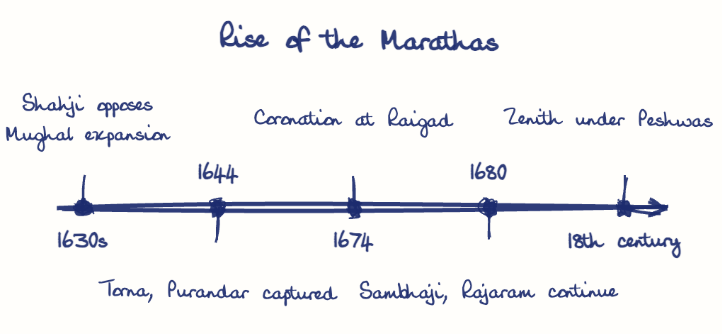
The Maratha Empire rose from Shahji's early resistance through Shivaji's fort conquests, guerrilla warfare and 1674 coronation at Raigad, then expanded under Sambhaji, Rajaram and the Peshwas. Shivaji's key contributions were a sovereign state, a navy guarding the Konkan coast and institutions like the Ashta Pradhan council.
Model answer
Ghissu Editorial · Verified 4 Oct 2026 · 261 words
Early Resistance and Expansion
Shahji Bhonsle’s defiance of Mughal authority laid the groundwork for Shivaji, who from the mid-1640s captured forts like Torna and Purandar, consolidating power with support from peasant-pastoralist groups such as the Mavlis and Kunbis.
Military Strategy and Diplomacy
Shivaji’s guerrilla warfare tactics exploited the Western Ghats terrain, while alliances with Golconda and Bijapur provided crucial military and financial support against the Mughals.
Administrative Reforms and Identity
The establishment of the Ashta Pradhan council institutionalized governance, and crafting a Kshatriya genealogy during coronation fostered a collective Swarajya identity uniting diverse social groups.
State Formation and Naval Power
Shivaji’s crowning transformed the Maratha polity into a sovereign kingdom; he also pioneered naval power to secure the Konkan coast, protecting trade routes and pioneering asymmetric warfare.
Cultural Symbolism and Legacy
His promotion of Hindu cultural revival underpins contemporary cultural nationalism, though his memory remains contested in caste and identity politics.
Governance Lessons
Shivaji’s administrative innovations, especially decentralization and local self-governance, offer valuable models for modern governance reforms.
This model answer is indicative and the model can make mistakes; please verify key facts independently.
Practise this question
1Get the answer sheet
Sized for this question.
2Write your answer
Timed, by hand.
3Get it marked
Your score and what to fix.
This chapter in the exam
The Mughals, the Marathas & the Advent of Europeans10 questions
Asked in 7 of 8 sittings since 2008
Most tested: Shivaji and the Maratha state formation, especially rise, administration and state character.
- 2025Discuss the establishment of the East India Company and its early operations in India.
- 2025What impact did the activities of Christian missionaries have on Indian society and culture?
All 10 questions, sorted by sub-topic, with model answers and practice.
Question from the official APPSC Group-I Mains 2020 paper. Answer written by Ghissu's engine and checked against our editorial standards. Found an error? Tell us and we correct it within 48 hours.