In the light of the All India Tiger Estimation Report 2018, critically evaluate the Project Tiger.
In short
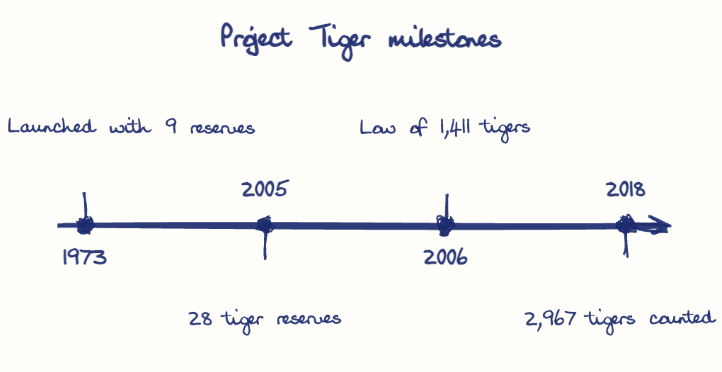
Judged by the 2018 estimation, Project Tiger has largely succeeded in reversing tiger decline through protection and scientific monitoring, though habitat shrinkage, uneven reserve management and human-wildlife conflict persist. Tiger numbers rose to 2,967 in 2018, from a low of 1,411 in 2006.
Model answer
Ghissu Editorial · Verified 4 Oct 2026 · 272 words
Population Recovery Success
Tiger numbers increased from 1,411 in 2006 to nearly 3,000 in 2018, showing Project Tiger’s impact through protection, habitat management, and anti-poaching. This rise reflects improved scientific monitoring and enforcement under the project’s framework.
Protected Area Expansion and Limitations
Tiger reserves grew from 9 in 1973 to 50 by 2018, covering over 70,000 sq km, but this is only about 2.2% of India’s land, insufficient for tiger range needs. Moreover, Management Effectiveness Assessment Framework (MEAF) reports reveal uneven governance and resource allocation across reserves, affecting conservation outcomes.
Data-Driven Monitoring and Community Role
Use of scientific methods like camera traps and MSTRIPES aligns with Project Tiger’s evolving monitoring; integrating panchayats through tools like the Panchayat Development Index can improve governance and local participation. However, gaps in data from some states indicate the need for capacity building and more inclusive conservation models.
Enhance Connectivity and Capacity
Strengthen corridors linking reserves and build state-level capacity, especially in Andhra Pradesh, for better enforcement and habitat management. This will reduce human-wildlife conflict and support sustainable tiger populations.
This model answer is indicative and the model can make mistakes; please verify key facts independently.
Sources
Practise this question
1Get the answer sheet
Sized for this question.
2Write your answer
Timed, by hand.
3Get it marked
Your score and what to fix.
This chapter in the exam
Fauna and Floral Geography5 questions
Asked in 3 of 8 sittings since 2008
Most tested: Andhra Pradesh-specific wildlife and biodiversity conservation
- 2025Discuss the key aspects of wildlife conservation and biodiversity in Andhra Pradesh.
- 2023Discuss the various forest conservation programmes in India.
All 5 questions, sorted by sub-topic, with model answers and practice.
Question from the official APPSC Group-I Mains 2020 paper. Answer written by Ghissu's engine and checked against our editorial standards. Found an error? Tell us and we correct it within 48 hours.