Write a brief note on the rural and urban population of Andhra Pradesh in the light of the census of India 2011.
In short
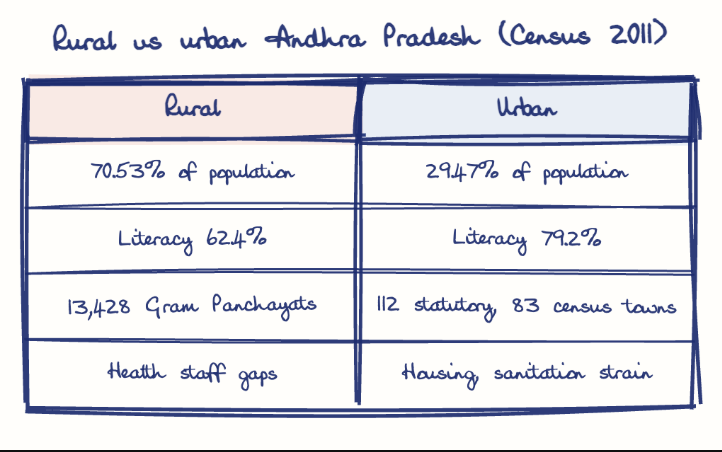
Census 2011 shows Andhra Pradesh as a predominantly rural state in transition, with about 70.53% of its 4.96 crore people living in villages and a steadily rising urban share. Urbanisation grew from 24.13% in 2001 to 29.47% in 2011, led by Visakhapatnam district at 47.45%.
Model answer
Ghissu Editorial · Verified 4 Oct 2026 · 269 words
Rural-Urban Distribution
Rural population growth is slowing, while urban areas like Visakhapatnam (47.45% urbanized) expand due to migration and economic opportunities. Vijayawada also shows rapid urban growth, reflecting industrialization and service sector expansion.
Literacy and Gender
Urban literacy (79.2%) surpasses rural (62.4%), with female literacy at 60%; sex ratio improved to 997 females per 1000 males, showing social progress. Scheduled Castes and Scheduled Tribes exhibit favorable sex ratios, indicating inclusive demographic changes.
Infrastructure and Services
Rapid urban growth strains housing and waste management, as per CAG audits; rural healthcare faces HR shortfalls per Andhra Pradesh Public Health3: HR Shortfalls and Service Gaps (CAG 2024). Urban local bodies struggle with sanitation and water supply, impacting quality of life.
Migration and Inequality
Rural-to-urban migration pressures cities; educational and gender gaps persist despite schemes like Samagra Shiksha Abhiyan. Rural areas suffer from inadequate healthcare access and educational infrastructure, limiting human development.
Policy Measures
Strengthen rural health via Janani Suraksha Yojana and PMSMA; improve urban planning and waste management using GIS tools; promote female literacy through digital education initiatives; and pursue integrated rural-urban development under National Rurban Mission to balance growth and reduce migration pressures.
This model answer is indicative and the model can make mistakes; please verify key facts independently.
Practise this question
1Get the answer sheet
Sized for this question.
2Write your answer
Timed, by hand.
3Get it marked
Your score and what to fix.
This chapter in the exam
Social Geography5 questions
Asked in 3 of 8 sittings since 2008
Most tested: Census-based composition and spatial distribution of Andhra Pradesh’s socially significant population groups
- 2025Analyse the composition and spatial distribution of Scheduled Castes (SCs), Scheduled Tribes (STs), and religious communities in Andhra Pradesh, as per Census 2011.
- 2023What are different types of rural settlements and factors affecting them ? Add a note on rural settlement patterns in India.
All 5 questions, sorted by sub-topic, with model answers and practice.
Question from the official APPSC Group-I Mains 2020 paper. Answer written by Ghissu's engine and checked against our editorial standards. Found an error? Tell us and we correct it within 48 hours.