Write a brief note on tribal population of Andhra Pradesh in the context of census report of 2011.
In short
Census 2011 counts about 27.4 lakh tribal people in present Andhra Pradesh, 5.53% of its population, concentrated in the hilly Agency Areas and lagging in literacy, health and income. Their sex ratio of 1012 females per 1000 males is better than the state average of 997.
Model answer
Ghissu Editorial · Verified 4 Oct 2026 · 283 words
Population Size and Location
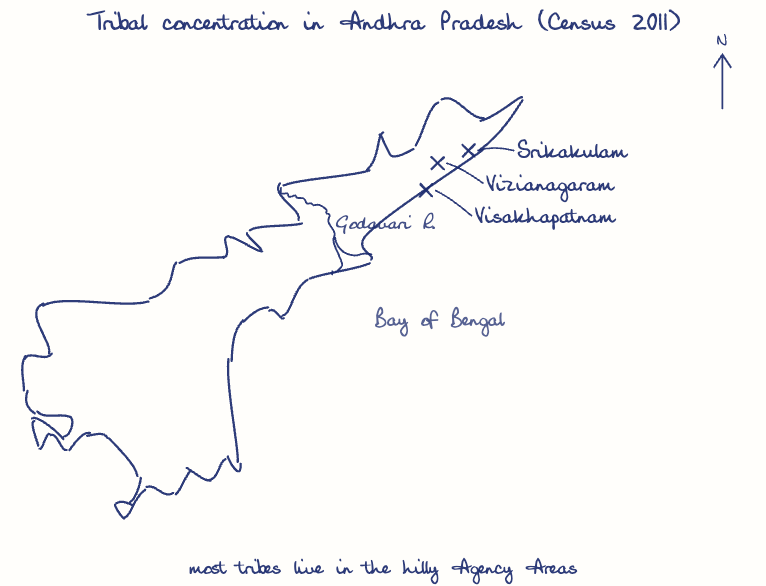
Tribes number about 27.4 lakh (5.53% of the residuary state), concentrated in Agency Areas of Visakhapatnam, East Godavari, West Godavari, Srikakulam, and Vizianagaram, mainly inhabiting hilly and forested terrains.
Sex Ratio and Literacy
The tribal sex ratio is 1012 females per 1000 males, surpassing state and national averages, indicating better gender balance. However, literacy rates, especially among females, lag behind the state average, reflecting persistent educational challenges.
Livelihoods and Poverty
Tribal economies vary from hunting-gathering to settled agriculture; many tribes like the Chenchu and Koya have transitioned to agriculture but still face widespread poverty. Despite schemes like Samagra Shiksha Abhiyan and ICDS, access to services remains limited.
Service Gaps and Urbanization
Health sector shortfalls in Andhra Pradesh, noted by the CAG 20242 report, affect tribal areas despite programs like Janani Suraksha Yojana and PMSMA. Tribal populations remain predominantly rural with minimal urban integration, limiting economic opportunities.
Targeted Welfare Programs
Integrated Tribal Development Agencies and PM-JANMAN for Particularly Vulnerable Tribal Groups like the Chenchus focus on tribal empowerment through education, health, and livelihood improvements, aiming to bridge socio-economic gaps.
Infrastructure Needs and Cultural Preservation
Census data calls for enhanced infrastructure in Agency Areas (roads, schools, health centers) to reduce disparities. Policies must also balance development with preserving tribal cultural identities and sustainable livelihoods.
This model answer is indicative and the model can make mistakes; please verify key facts independently.
Practise this question
1Get the answer sheet
Sized for this question.
2Write your answer
Timed, by hand.
3Get it marked
Your score and what to fix.
This chapter in the exam
Social Geography5 questions
Asked in 3 of 8 sittings since 2008
Most tested: Census-based composition and spatial distribution of Andhra Pradesh’s socially significant population groups
- 2025Analyse the composition and spatial distribution of Scheduled Castes (SCs), Scheduled Tribes (STs), and religious communities in Andhra Pradesh, as per Census 2011.
- 2023What are different types of rural settlements and factors affecting them ? Add a note on rural settlement patterns in India.
All 5 questions, sorted by sub-topic, with model answers and practice.
Question from the official APPSC Group-I Mains 2020 paper. Answer written by Ghissu's engine and checked against our editorial standards. Found an error? Tell us and we correct it within 48 hours.