Describe the role of NGOs and Civil Services in Democracy.
In short
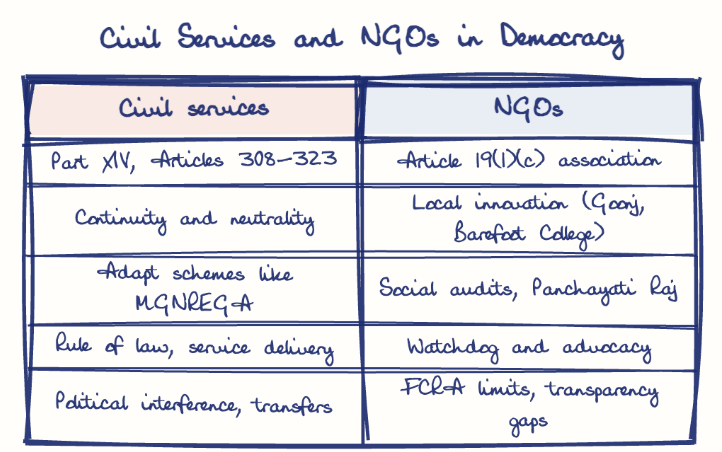
Civil services, mandated under Part XIV (Articles 308-323), provide neutral, continuous administration, while NGOs, protected by Article 19(1)(c), mobilise marginalised communities, run social audits and act as watchdogs. Both face hurdles: political interference for civil servants and weak transparency for NGOs, the latter tracked through NITI Aayog's NGO-DARPAN portal.
Model answer
Ghissu Editorial · Verified 4 Oct 2026 · 265 words
Constitutional and Legal Basis
Civil services are constitutionally mandated under Part XIV (Articles 308-323); NGOs operate under Article 19(1)(c) and the Societies Registration Act, 1860, enabling democratic functions.
Training and Expertise
The National Centre for Good Governance (NCGG) trained 958 civil servants in 2024-25; NGOs like Goonj and Barefoot College bring grassroots innovation and community empowerment.
Regulatory Oversight
The Foreign Contribution Regulation Act (FCRA) restricts NGO funding; NITI Aayog’s NGO-DARPAN portal improves transparency; civil services are governed by Articles 309-311 ensuring accountability.
Capacity Building
NSCSTI standards enhance civil service training quality; NGOs invest in professional development through institutions like Azim Premji University.
Bridging Policy and People
Civil services adapt schemes like MGNREGA to local needs in Rayalaseema; NGOs mobilize marginalized groups, e.g., Aid India’s COVID-19 health outreach in Andhra Pradesh.
Democratic Participation
NGOs promote participatory democracy via Panchayati Raj support and social audits but face concerns over internal democracy and representativeness.
Transparency and Collaboration
Mandate public disclosure of NGO finances and civil service performance; foster partnerships via NGO-DARPAN in Andhra Pradesh.
Regulatory Reforms and Capacity Building
Balance FCRA rules to protect national interests without stifling NGOs; expand training on participatory governance for civil servants and NGO leaders.
This model answer is indicative and the model can make mistakes; please verify key facts independently.
Practise this question
1Get the answer sheet
Sized for this question.
2Write your answer
Timed, by hand.
3Get it marked
Your score and what to fix.
This chapter in the exam
Development processes: civil society and NGOs7 questions
Asked in 3 of 8 sittings since 2008
Most tested: Role of NGOs/civil society in democracy and social justice
- 2025What do you understand by civil society in the Indian context? Discuss its key features and the limitations it faces in a democratic system.
- 2025In what ways can the role of NGOs be enhanced in promoting women's empowerment and welfare in India? Discuss, with a focus on the key challenges they encounter.
All 7 questions, sorted by sub-topic, with model answers and practice.
Question from the official APPSC Group-I Mains 2020 paper. Answer written by Ghissu's engine and checked against our editorial standards. Found an error? Tell us and we correct it within 48 hours.