What do you understand by civil society in the Indian context? Discuss its key features and the limitations it faces in a democratic system.
In short
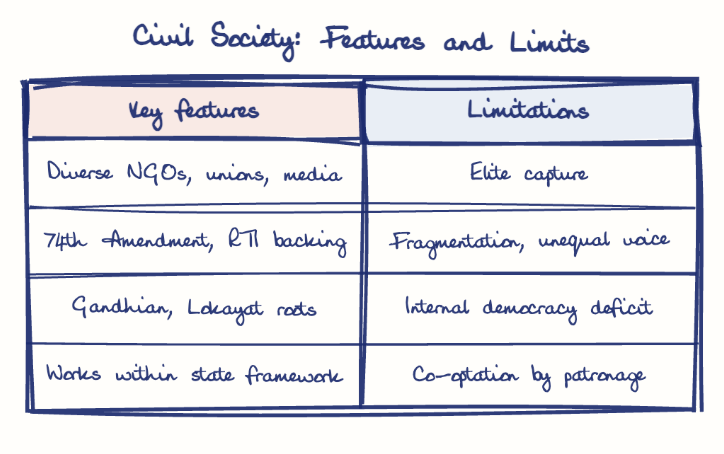
Civil society in India is the space between state and individual: NGOs, associations, media, unions and citizen collectives that hold power to account, backed by the 74th Amendment and RTI Act 2005. Its limitations include elite capture, fragmentation, weak internal democracy and co-optation through state funding or political patronage.
Model answer
Ghissu Editorial · Verified 4 Oct 2026 · 277 words
Diverse Composition and Historical Roots
Indian civil society spans NGOs, trade unions, media, and informal groups, drawing from indigenous traditions like the Lokayat movement and Gandhian volunteerism. It reflects India’s social heterogeneity and multiple interests, evolving through social movements on caste, gender, environment, and rights.
Constitutional and Legal Backing
The 74th Amendment institutionalised decentralisation and participatory governance, while the RTI Act (2005) improved transparency, enabling civil society’s active governance role. These legal frameworks empower citizens and CSOs to hold the state accountable and participate in local decision-making.
Co-optation and Internal Democracy Deficits
Political patronage and state funding risk corrupting civil society, diverting focus from public interest. Some organisations lack internal transparency and democratic functioning, undermining their legitimacy and democratic goals.
Grassroots Inclusion and Legal Empowerment
Policies promoting marginalised participation, as in Andhra Pradesh’s Ward Committees and social audits, enhance democratic engagement and accountability at the local level. Capacity building and legal support empower grassroots groups to engage effectively with state institutions.
This model answer is indicative and the model can make mistakes; please verify key facts independently.
Practise this question
1Get the answer sheet
Sized for this question.
2Write your answer
Timed, by hand.
3Get it marked
Your score and what to fix.
This chapter in the exam
Development processes: civil society and NGOs7 questions
Asked in 3 of 8 sittings since 2008
Most tested: Role of NGOs/civil society in democracy and social justice
- 2025In what ways can the role of NGOs be enhanced in promoting women's empowerment and welfare in India? Discuss, with a focus on the key challenges they encounter.
- 2023"The making of the Right to Information Act, 2005 in India has been largely attributed to the success of civil society movement." Comment.
All 7 questions, sorted by sub-topic, with model answers and practice.
Question from the official APPSC Group-I Mains 2025 paper. Answer written by Ghissu's engine and checked against our editorial standards. Found an error? Tell us and we correct it within 48 hours.